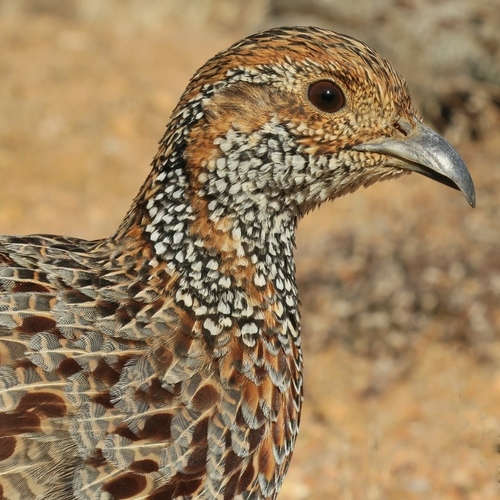
Gray-winged Francolin
Scleroptila afra
A master of mountain camouflage, the Gray-winged Francolin is the soulful voice of the South African highlands. Spotting one requires a keen eye for its speckled throat and a love for the morning's first light.
Quick Identification
Size
30–33 cm (12–13 in) in length; Weight: 350–450 g (12–16 oz)
Colors
Mottled grey and brown upperparts with intricate barring; distinctive greyish-white throat finely speckled with black; rufous-orange belly and flight feathers.
Key Features
- Greyish-white throat speckled with black
- Rufous flight feathers prominent during flight
- Bold reddish-orange patch on the lower belly
- Stocky, partridge-like body with short, sturdy legs
When You’ll See Them
Geographic range
Where Does the Gray-winged Francolin Live?
The Gray-winged Francolin is a native resident of the southern African continent, specifically endemic to the countries of South Africa and Lesotho. Its core range is concentrated within the high-elevation grasslands of the Drakensberg mountains and the unique Fynbos biome of the Western and Eastern Cape provinces. While it is stable in these regions, it is rarely found in the lower, more arid northern reaches of the country.
Basemap © OpenStreetMap contributors
Behavior
The Gray-winged Francolin is a highly social and vocal bird, typically found in small family groups or coveys ranging from 4 to 12 individuals. They are famously territorial, particularly during the breeding season when the males perform loud, repetitive calling bouts from rocky vantage points to signal their presence to neighbors.
These birds are predominantly terrestrial, preferring to escape predators by running through thick grass rather than taking flight. However, when flushed, they explode into the air with a characteristic whirr of wings, revealing bright rufous feathers. They spend a significant portion of their day foraging on the ground, but are also known to frequent stony outcrops in the early morning to sun themselves before the day's heat sets in.
EverydayEarth exclusive
Camera Tips
To capture the Gray-winged Francolin on a backyard or trail camera, placement is everything. These birds are strictly ground-dwellers, so your camera should be mounted no higher than 30 to 50 centimeters (12–20 inches) off the ground. Aiming the camera along established game trails through tall grass or at the base of rocky outcrops where they sun themselves will yield the best results. A slightly downward angle helps capture the intricate detail of their speckled throat, which is their most defining feature.
While they don't typically visit traditional bird feeders, you can attract them by creating a 'dust bath' area—a patch of loose, dry soil in a sunny, sheltered spot. They are also drawn to shallow, ground-level water features, especially in the drier winter months. If you live on a farm or a large property, placing your camera near the edges of grain fields or recently disturbed soil where they dig for bulbs can be very productive.
Set your camera to take rapid-fire bursts or short video clips. Francolins often move in groups, and a single photo might only catch the first bird, missing the rest of the covey. Because they are most active during the 'golden hours' of dawn and dusk, ensure your camera has a fast trigger speed to handle the lower light levels without blurring their movement.
Similar Species
Species that look similar or are commonly confused with Gray-winged Francolin.
Red-winged Francolin
Lacks the finely speckled grey throat and has a bolder, cleaner white throat patch.
Orange River Francolin
Features a much bolder facial pattern and is found in drier, more northerly scrub habitats.
Cape Spurfowl
Larger and darker overall with fine white streaking rather than the rufous wing patches of the Gray-winged.
Frequently Asked Questions
Record Gray-winged Francolin at your habitat
Connect a camera to start building your own species record — AI identifies every visitor automatically.