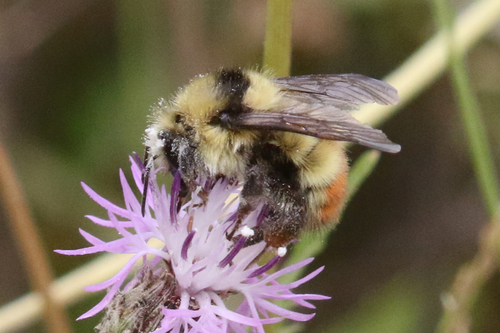
Great Basin Bumble Bee
Bombus centralis
A vibrant specialist of the American West, the Great Basin Bumble Bee is easily recognized by its striking orange-banded abdomen. This long-tongued pollinator is a vital link in the health of both mountain meadows and suburban gardens.
Quick Identification
Size
Queens: 15–19 mm (0.6–0.75 in); Workers: 10–13 mm (0.4–0.5 in); Males: 11–14 mm (0.4–0.55 in)
Colors
Thorax is primarily yellow with a black band between the wings; abdomen features yellow on the first two segments, followed by two bright orange-red segments and a black tip.
Key Features
- Distinct black band across the thorax between wing bases
- Vivid orange-red hair on abdominal segments 3 and 4
- Elongated face and long tongue adapted for deep flowers
- Yellow hair on the first two abdominal segments
When You’ll See Them
Behavior
The Great Basin Bumble Bee is a highly efficient pollinator known for its 'buzz pollination' capability, where it vibrates its thoracic muscles to release stubborn pollen from flowers. These bees are social insects that follow a seasonal colony cycle. A single queen emerges from hibernation in the spring to locate a suitable underground nesting site—often a discarded rodent burrow—where she raises the first generation of workers herself.
In the backyard setting, these bees are remarkably docile. They are far more interested in foraging for nectar and pollen than interacting with humans. While they can sting, they generally only do so if their nest is physically disturbed or if they are stepped on. By late summer, the colony produces new queens and males, who leave the nest to mate before the rest of the colony dies off with the first hard frost.
EverydayEarth exclusive
Camera Tips
To capture the Great Basin Bumble Bee on camera, you need to focus your lens where the food is. Unlike larger mammals that follow trails, these bees follow 'bloom trails.' Identify the most active flowering plant in your yard—specifically look for tubular flowers like Penstemon or Agastache. Set your camera on a tripod or mount it within 12 to 18 inches of the flower clusters. Because these bees move rapidly between blooms, a camera with a high-speed 'Burst Mode' or a trigger speed of 0.2 seconds or less is essential for capturing them in flight.
Lighting is your best friend when filming insects. Position your camera so the sun is at a 45-degree angle to the side of the flower. This 'side-lighting' highlights the fine hairs on the bee's thorax and the translucent texture of their wings, which can often appear as a blur if the shutter speed isn't fast enough. If your camera allows for manual settings, prioritize a fast shutter speed (1/1000th or higher) to freeze the motion of their wings, which beat at roughly 200 times per second.
For the best results, use a macro lens or a 'Macro' setting on your AI camera. The Great Basin Bumble Bee is relatively small, so filling the frame is difficult from a distance. If you are using a trail camera, ensure it has a close-focusing distance; otherwise, the bee will appear as a fuzzy yellow dot. You can also 'bait' a specific spot for your camera by planting a high-density cluster of native Bee Balm, which acts as a natural stage for the bees to land on and remain relatively still while they drink nectar.
Similar Species
Species that look similar or are commonly confused with Great Basin Bumble Bee.
Nevada Bumble Bee
Much larger in size with a notably longer thorax and typically lacks the bright orange-red abdominal segments.
Red-belted Bumble Bee
The orange/red color is usually on the second and third segments rather than the third and fourth, and the hair is much shorter and more 'cropped' looking.
Frequently Asked Questions
Record Great Basin Bumble Bee at your habitat
Connect a camera to start building your own species record — AI identifies every visitor automatically.