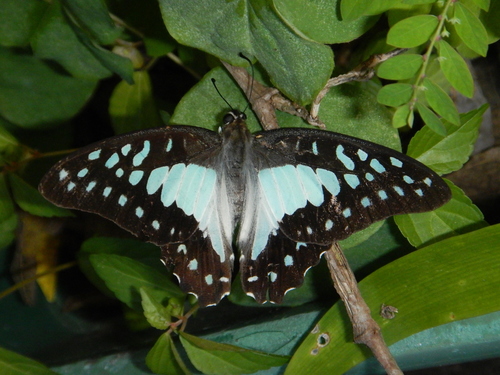
Great Jay
Graphium eurypylus
A flash of emerald in the tropical sun, the Great Jay is one of the fastest and most vibrant butterflies in the Indomalayan region. With its striking pale green triangles and lightning-quick flight, it is a prized sighting for any backyard naturalist.
Quick Identification
Size
Wingspan of 70–90 mm (2.75–3.5 inches)
Colors
Jet black to dark chocolate background with semi-translucent pale green or aquamarine spots; underside has distinct red and yellow markings at the wing base.
Key Features
- Triangular arrangement of pale green spots on forewings
- Bold red spots visible on the underside of the hindwings
- Swift, erratic flight pattern with rapid wing beats
When You’ll See Them
Geographic range
Where Does the Great Jay Live?
The Great Jay is a tropical gem primarily found in the lush Indomalayan and Australasian regions. Its native range stretches from the sub-Himalayan regions of India across the dense rainforests of Southeast Asia, including Thailand, Vietnam, and Indonesia. In the south, its territory extends into the tropical northern regions of Australia, where it thrives in moist, coastal habitats and tropical woodlands.
Basemap © OpenStreetMap contributors
Behavior
The Great Jay is a high-energy butterfly known for its incredibly fast and erratic flight. Unlike many butterflies that glide gracefully, the Great Jay zips between flowers and sun-dappled leaves with a sense of urgency. They are highly active during the brightest parts of the day, frequently visiting gardens to drink nectar or darting along forest edges in search of mates.
Male Great Jays exhibit a fascinating social behavior known as 'puddling.' They congregate on damp patches of sand, mud, or even carrion to extract essential minerals and sodium, which they later pass to females during mating. This social gathering provides the best opportunity for observers to see them up close, as they are otherwise difficult to track in flight.
EverydayEarth exclusive
Camera Tips
Capturing the Great Jay on camera requires speed and strategy because of their rapid flight. To increase your success, position your AI-powered camera near high-nectar 'butterfly magnet' plants like Lantana, Buddleja, or Ixora. Because these butterflies rarely stay still for long, set your camera to its highest possible shutter speed and use a burst mode or high-frame-rate video to freeze their motion.
For the best close-ups, try creating a 'puddling station' within the camera's field of view. Mix sand with a small amount of salt or compost and keep it moist with a drip system. Place this in a sunny spot on the ground. Males will be lured to the minerals, often staying still for several minutes at a time, allowing for high-detail identification shots that are impossible when they are in the canopy.
Placement is key for light quality. These butterflies look most vibrant when front-lit by the sun, which makes their pale green spots appear to glow. Position your camera facing away from the sun (North-facing in the Northern Hemisphere, South-facing in the Southern) to catch the light hitting their wings. Ensure the camera is mounted at a low angle (roughly 1-2 feet off the ground) for puddling shots or chest-height for floral shots.
Similar Species
Species that look similar or are commonly confused with Great Jay.
Frequently Asked Questions
Record Great Jay at your habitat
Connect a camera to start building your own species record — AI identifies every visitor automatically.