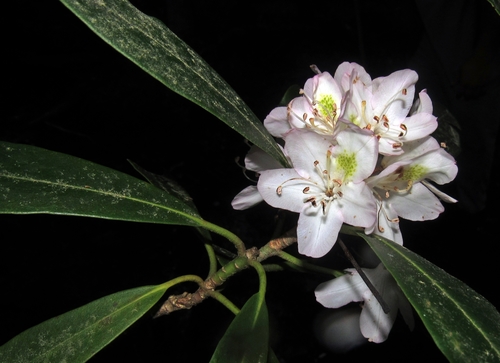
great rhododendron
Rhododendron maximum
The 'Great Laurel' of the Appalachians, this towering evergreen turns shaded woodlands into lush, floral sanctuaries with its massive leaves and delicate summer blooms.
Quick Identification
Size
A large shrub or small tree typically reaching 13-40 feet (4-12 meters) in height with leaves 4-12 inches (10-30 cm) long.
Colors
Dark, leathery olive-green leaves; flowers are white to pale pink with small greenish-yellow spots on the upper petal.
Key Features
- Large, elongated evergreen leaves up to 1 foot long
- Dense clusters of bell-shaped white or rose-colored flowers
- Twisting, multi-stemmed growth habit forming thickets
- Sticky flower stems and glandular hairs on new growth
When You’ll See Them
Behavior
The great rhododendron is a slow-growing, long-lived evergreen that plays a vital role in forest ecology. It is famous for forming dense, nearly impenetrable thickets known as 'rhododendron hells' along mountain streams and shaded slopes. These thickets provide critical thermal cover for white-tailed deer and nesting sites for various songbirds, particularly the Black-throated Blue Warbler.
One of its most fascinating biological 'behaviors' is its reaction to extreme cold. When temperatures drop below freezing, the leaves droop and curl into tight cylinders. This thermotropic movement protects the leaf membranes from rapid temperature changes and reduces water loss. In the garden or wild, it acts as a natural thermometer; the tighter the curl, the colder the air.
EverydayEarth exclusive
Camera Tips
When monitoring a great rhododendron with a trail camera, your goal is often less about the plant itself and more about the wildlife it attracts. Because these shrubs create dense 'tunnels,' they are natural highways for mammals. Position your camera about 2 feet off the ground, angled along a natural opening in the thicket. This is an excellent spot to capture bobcats, bears, or foxes using the dense cover for transit. Use a wide-angle lens setting if available, as the close quarters of a rhododendron grove can make framing difficult.
For those interested in the botanical beauty of the great rhododendron, use the time-lapse mode during late June and early July. Set your camera to take a photo every 30 minutes during daylight hours to capture the 'Great Laurel' blooms opening. Because these plants thrive in deep shade, you may need to adjust your camera's exposure settings or choose a model with high-quality low-light sensors to avoid grainy images. The dark, waxy leaves can also cause 'flash bounce' at night, so try to position the camera at a slight 45-degree angle to the foliage rather than head-on.
In the winter, the great rhododendron becomes a fascinating subject for a 'weather cam.' By pointing a camera at a specific cluster of leaves against a ruler or a fixed background, you can document the leaf-curling phenomenon mentioned earlier. This is a great educational project; you can time-lapse the leaves unfurling as the sun hits them in the morning. For the best results, ensure the camera is mounted to a very sturdy post or tree, as the heavy snow that often clings to these evergreens can sag branches and obscure your view.
Similar Species
Species that look similar or are commonly confused with great rhododendron.
Frequently Asked Questions
Record great rhododendron at your habitat
Connect a camera to start building your own species record — AI identifies every visitor automatically.