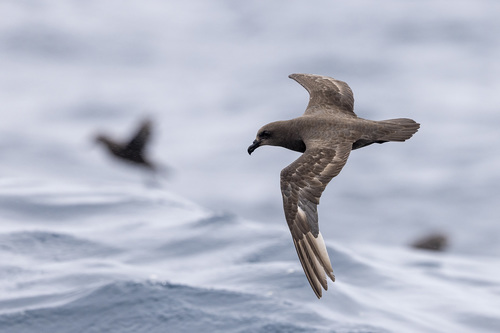
Great-winged Petrel
Pterodroma macroptera
A dark-winged nomad of the Southern Ocean, the Great-winged Petrel is a marvel of endurance and night-time navigation. Spending years at sea, this mysterious seabird returns to remote islands only under the cover of darkness.
Quick Identification
Size
Length 42–45 cm (16–18 in); wingspan 102–112 cm (40–44 in); weight 500–800 g (1.1–1.8 lbs)
Colors
Uniformly dark chocolate-brown to sooty black; bill and legs are black; face may show a faint grayish wash
Key Features
- Entirely dark sooty plumage
- Heavy, hooked black bill with prominent tube-nostrils
- Long, narrow wings for dynamic soaring
- Short, wedge-shaped tail
When You’ll See Them
Geographic range
Where Does the Great-winged Petrel Live?
The Great-winged Petrel is a true citizen of the Southern Ocean, circumpolar in its distribution between the subtropics and the Antarctic pack ice. It is native to the southern reaches of the Atlantic and Indian Oceans, with core breeding populations concentrated on the Tristan da Cunha archipelago and Gough Island. Outside of the nesting season, these tireless voyagers roam widely across the high seas, frequently appearing in the offshore waters of South Africa, Australia, and southern South America.
Basemap © OpenStreetMap contributors
Behavior
The Great-winged Petrel is a master of the open ocean, spending the vast majority of its life on the wing. It utilizes dynamic soaring, a flight technique that allows it to travel thousands of miles by harvesting energy from the wind gradients above the waves. Unlike many other petrels, it is largely solitary at sea, though it may congregate where food is exceptionally abundant, such as over deep-water canyons or upwelling zones.
During the breeding season, these birds become strictly nocturnal when visiting their land-based burrows to avoid predation by gulls and skuas. On the ground, they are somewhat clumsy but highly vocal, using a series of whistles and low moans to communicate with mates. They are known for their incredible stamina, often embarking on foraging trips that last several days and cover hundreds of miles while their partner incubates the egg.
EverydayEarth exclusive
Camera Tips
Capturing the Great-winged Petrel on camera is a unique challenge because they are almost exclusively pelagic. If you are located on a remote island near a known colony, your best bet is to set up your camera near burrow entrances. Because these birds are strictly nocturnal on land, you must ensure your camera has high-quality infrared (IR) night vision capabilities. Use a 'No-Glow' IR flash to avoid startling the birds or attracting unwanted attention from scavengers.
Position your camera low to the ground, about 12-18 inches high, angled slightly upward toward the mouth of a nesting burrow or a prominent 'take-off' rock. These birds are heavy and clumsy on land; they often walk to specific high points to catch the wind for launch. A fast trigger speed is essential, as their movements near the burrow can be surprisingly quick when they are trying to avoid potential predators like skuas.
Since these are wild seabirds, never use food as bait, as this can disrupt their natural diet or attract invasive predators like rats or cats to the nesting site. Instead, focus on the timing: the best footage is usually captured during the austral winter (May to October) when adults are returning to feed chicks. Setting your camera to video mode is highly recommended to capture their unique vocalizations, which are a central part of their social behavior at the colony.
Lastly, consider the weather. These birds thrive in high-wind conditions. If you are monitoring a coastal take-off point, a camera with a sturdy mount is necessary to prevent 'false triggers' caused by wind-shaken vegetation. Ensure your housing is saltwater resistant, as salt spray can quickly corrode standard electronics in these maritime environments.
Similar Species
Species that look similar or are commonly confused with Great-winged Petrel.
Frequently Asked Questions
Record Great-winged Petrel at your habitat
Connect a camera to start building your own species record — AI identifies every visitor automatically.