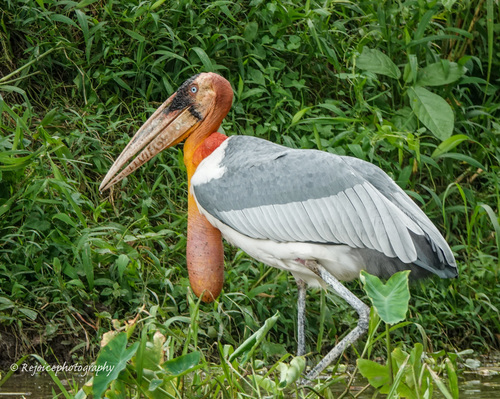
Greater Adjutant
Leptoptilos dubius
The Greater Adjutant is one of the world's rarest and most misunderstood storks. With its massive bill and prehistoric silhouette, this 'hargila' or bone-swallower is a majestic survivor of the Asian wetlands.
Quick Identification
Size
Stands 145-150 cm (57-59 in) tall; wingspan of 250 cm (98 in); weighs between 8-11 kg (17.6-24.3 lbs).
Colors
Slate-grey upperparts with contrasting white underparts. The bare head and neck are pinkish-yellow, while the massive bill is a dull horn color. During breeding, wing feathers take on a silvery-grey sheen.
Key Features
- Enormous, thick wedge-shaped bill
- Distinctive inflatable orange-yellow neck pouch
- Naked, featherless head and neck
- Stiff, upright 'military' walking gait
When You’ll See Them
Geographic range
Where Does the Greater Adjutant Live?
Native to the Indian subcontinent and parts of Southeast Asia, the Greater Adjutant's range is now critically fragmented. Today, the world's largest breeding populations are found in the Brahmaputra Valley of Assam, India, and the state of Bihar, with a smaller, isolated population residing in the Tonle Sap region of Cambodia. While they once soared across much of Southern Asia, they are now localized specialists restricted to these few remaining strongholds.
Basemap © OpenStreetMap contributors
Behavior
The Greater Adjutant is a fascinating, social scavenger that spends much of its day soaring on warm air thermals, much like a vulture. On the ground, it is famous for its 'military' gait—a stiff, measured walk that earned it its English name. Despite their somewhat somber appearance, they are gregarious birds, often congregating in large numbers at feeding sites or communal roosting trees.
In human-dominated landscapes, they have adapted to scavenge alongside people, often visiting landfills or fishing villages. They are generally quiet birds, but during the breeding season, they engage in loud bill-clattering and guttural croaking to communicate with mates. Their role as nature's 'cleanup crew' is vital, as they help remove carrion and organic waste from the environment.
EverydayEarth exclusive
Camera Tips
To capture the Greater Adjutant on a trail camera, you need to account for their massive height. Place your camera 3 to 5 feet off the ground, but tilt it slightly upward; a standard chest-high placement for mammals might only capture this bird's legs. If you are monitoring a nesting site, choose a wide-angle lens setting, as these birds have an immense wingspan that can easily blur if they are too close to the sensor.
While we don't recommend baiting with carrion in residential areas, placing cameras near the edges of drying wetlands or near large, isolated nesting trees (like Kadams or Silk Cottons) is highly effective. These birds are creatures of habit and will often return to the same roosting or sunning spots daily.
Because they are most active during the heat of the day when they soar, set your camera's trigger interval to be very short. They often land with a heavy, lumbering motion that can be captured beautifully in high-speed video modes. Ensure your shutter speed is high (at least 1/1000s if your camera allows) to freeze the motion of their large wings during takeoff or landing.
In terms of seasonal timing, focus your efforts during the dry season (winter and spring in India). As water levels recede in wetlands, these birds congregate in high densities to forage for trapped fish, providing the perfect opportunity for multi-subject captures. Always use a high-capacity SD card, as their social interactions can trigger hundreds of photos in a single afternoon.
Similar Species
Species that look similar or are commonly confused with Greater Adjutant.
Lesser Adjutant
Smaller with a thinner bill and lacks the inflatable hanging neck pouch found on the Greater Adjutant.
Marabou Stork
Very similar in appearance but native only to Africa; it has more extensive white fluff on its back and neck.
Painted Stork
Much smaller and more colorful, with a yellow down-curved bill and pinkish feathers near the tail.
Frequently Asked Questions
Record Greater Adjutant at your habitat
Connect a camera to start building your own species record — AI identifies every visitor automatically.