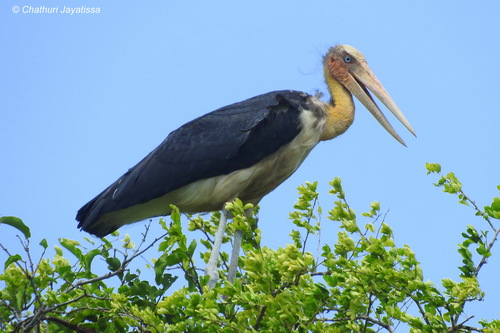
Lesser Adjutant
Leptoptilos javanicus
A towering and prehistoric-looking resident of Asian wetlands, the Lesser Adjutant commands attention with its massive bill and stoic presence. This vulnerable stork is a master of the slow-motion hunt, making it a prized subject for patient backyard naturalists.
Quick Identification
Size
Length: 110–120 cm (43–47 in); Wingspan: ~210 cm (83 in); Weight: 4–6 kg (9–13 lbs)
Colors
Slate-black upperparts with a copper sheen; white belly and undertail; bare yellowish head and neck; pale, thick wedge-shaped bill.
Key Features
- Massive wedge-shaped bill
- Bare yellowish-to-flesh-colored head and neck
- Glossy black wings and back contrasting with white underparts
- Stiff, upright 'military' posture when standing
When You’ll See Them
Geographic range
Where Does the Lesser Adjutant Live?
The Lesser Adjutant is native to the tropical and subtropical regions of South and Southeast Asia. Its range is centered across the Indian subcontinent, including India, Nepal, Sri Lanka, and Bangladesh, extending eastward through Myanmar, Thailand, and Indochina. It is also found across the islands of Indonesia, particularly in Sumatra and Borneo, though populations are increasingly fragmented due to habitat loss.
Basemap © OpenStreetMap contributors
Behavior
The Lesser Adjutant is a solitary and somewhat stoic figure of the Asian wetlands. Unlike its more social relative, the Greater Adjutant, this species is rarely seen in large flocks and generally avoids human-dominated waste sites or urban centers. It spends much of its day slowly stalking through shallow water or tall grass with a measured, deliberate gait, searching for prey with its powerful bill held ready.
These birds are primarily silent but may perform bill-clattering displays during the breeding season at their nest sites. They are known for their impressive soaring ability, using thermals to rise high into the sky during the heat of the day. In areas where they coexist with rural farming, they have adapted to foraging in rice paddies, often maintaining a cautious but stable distance from local farmers.
EverydayEarth exclusive
Camera Tips
Capturing a Lesser Adjutant on camera requires strategic placement near water. These birds are tall, so your camera should be mounted higher than a standard trail cam setup for small mammals; aim for a height of 3 to 4 feet (1 to 1.2 meters) to ensure you capture the head and bill, not just the legs. If you are monitoring a wetland or rice paddy edge, position the camera to face north or south to avoid the harsh glare of the tropical sun reflecting off the water, which can blow out the white details on the bird's belly.
Avoid using traditional food baits, as Lesser Adjutants are wary and prefer live, moving prey. Instead, look for 'funnel points' in the landscape—natural clearings in reeds or specific shallow points in a pond where the bird is likely to step out to forage. Because they move slowly and deliberately, set your camera to take multi-shot bursts or short videos (15-20 seconds). This will allow you to capture their unique stalking behavior and bill-probing techniques that a single still photo might miss.
During the breeding season, usually between October and May depending on the region, these birds may frequent specific tall trees for nesting. If you are lucky enough to have a nesting tree nearby, mounting a camera with a telephoto lens or a high-quality sensor on a nearby structure can yield incredible footage of their parental care. Keep in mind that these birds are sensitive to disturbance; always set up your equipment quickly and keep your distance to ensure they don't abandon the site.
Similar Species
Species that look similar or are commonly confused with Lesser Adjutant.
Greater Adjutant
Larger body size, presence of a prominent inflatable neck pouch, and a thicker, more massive bill.
Painted Stork
Smaller with a distinctive downward-curved yellow bill and pinkish feathers on the wings.
Milky Stork
Mostly white plumage across the body and wings, lacking the dark slate-black back of the Lesser Adjutant.
Frequently Asked Questions
Record Lesser Adjutant at your habitat
Connect a camera to start building your own species record — AI identifies every visitor automatically.