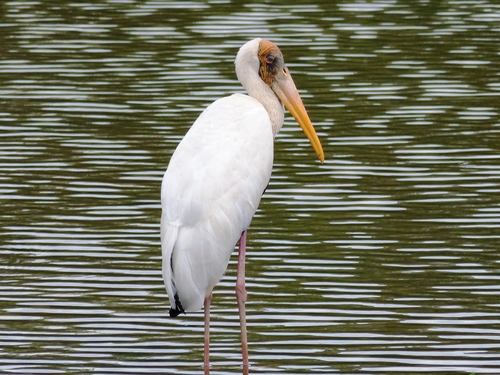
Milky Stork
Mycteria cinerea
The Milky Stork is a majestic, snowy-white wader and one of Southeast Asia's most endangered coastal birds. Watch as it gracefully patrols the mangrove mudflats, using its sensitive golden bill to dance through the shallow waters.
Quick Identification
Size
Stands 91–97 cm (36–38 in) tall with a wingspan of approximately 150–160 cm (59–63 in); weights range from 2–2.5 kg (4.4–5.5 lbs).
Colors
Pure milky-white body plumage; black flight feathers on the wings and tail; yellow to orange-yellow bill; reddish-orange bare facial skin; dull pink or greyish legs.
Key Features
- Large, slightly decurved yellow-orange bill
- Deep black flight feathers contrasting with white body
- Bare, reddish-orange facial skin around the eyes
- Long, greyish-pink legs suitable for wading
When You’ll See Them
Geographic range
Where Does the Milky Stork Live?
The Milky Stork is a rare gem of Southeast Asia, with its heartland located in the vast mangrove forests and coastal wetlands of Indonesia, particularly on the islands of Sumatra, Java, and Sulawesi. While they are occasionally spotted in the coastal reaches of Malaysia, Cambodia, and southern Vietnam, their range has become increasingly fragmented over the last several decades. Unlike some more adaptable storks, this species remains a regional specialist, rarely wandering far from the tropical coastlines of the Malay Archipelago.
Basemap © OpenStreetMap contributors
Behavior
The Milky Stork is a highly social and methodical wader, often seen foraging in small groups or alongside other waterbirds like herons and egrets. They are primarily tactile feeders, meaning they rely on touch rather than sight to catch their prey. You will often see them standing in shallow water, partially opening their bills and sweeping them through the mud or water until they feel the movement of a fish or crustacean.
These birds are generally quiet but can become quite animated during the breeding season, performing greeting ceremonies at the nest that involve bill-clattering and wing-shrugging. Despite their large size, they are graceful fliers, often utilizing warm air thermals to soar high above the coastal mangroves where they roost and nest in large, communal colonies.
Interaction with humans is unfortunately characterized by the species' sensitivity to habitat disturbance. As a shy bird that relies on specific coastal ecosystems, they tend to avoid areas with heavy human traffic. Their populations have suffered significantly from coastal development and the harvesting of eggs and chicks, making them a rare and special sight for any backyard observer living near their remaining habitats.
EverydayEarth exclusive
Camera Tips
Capturing the Milky Stork on a trail camera requires strategic placement near the water's edge. Because they are tactile foragers, they frequent tidal mudflats and the margins of mangrove swamps. Mount your camera on a sturdy mangrove root or a specialized stake about 2 feet above the ground. Angle the lens slightly downward (15-20 degrees) toward the shallow water where the birds are likely to sweep their bills. This low angle captures the reflection of the bird in the water and provides a much more intimate perspective than a high-mounted camera.
Since the Milky Stork is almost entirely white, your biggest technical challenge will be exposure. In the bright, midday tropical sun, their feathers can easily 'blow out' and lose all detail. If your camera allows for exposure compensation, set it to -0.5 or -1.0. This will help preserve the texture of the feathers. Use a camera with a fast trigger speed (under 0.3 seconds) because, while they look slow, their strike when catching a fish is lightning fast. High-resolution video settings are preferred to capture their unique 'foot-stirring' behavior used to flush out prey.
Timing is everything with this species. They are most active during low tide when the mudflats are exposed and prey is trapped in shallow pools. Check local tide tables and ensure your camera is active during these windows. If you are setting up in a backyard that borders a wetland, avoid using artificial lures or bait, as these birds are highly specialized and sensitive. Instead, ensure your camera has a clear line of sight to a naturally occurring 'bottleneck' in a stream or a clear patch of mudflat where they have been seen before.
Finally, because these birds are Endangered, ethics must come first. Never place a camera near a nesting site, as this can cause the parents to abandon the eggs or chicks. Use a high-quality PIR (passive infrared) sensor that can trigger from a distance, allowing you to place the camera 15-20 feet away from their preferred foraging spot. This ensures you capture natural behavior without the bird feeling pressured or threatened by the device.
Similar Species
Species that look similar or are commonly confused with Milky Stork.
Painted Stork
Look for the black chest band and bright pink 'painted' feathers near the tail, which the Milky Stork lacks.
Great Egret
Much thinner bill and neck; lacks the black wing feathers and reddish facial skin of the Milky Stork.
Lesser Adjutant
Larger and much darker; has a grey/black back and wings compared to the Milky Stork's white body.
Frequently Asked Questions
Record Milky Stork at your habitat
Connect a camera to start building your own species record — AI identifies every visitor automatically.