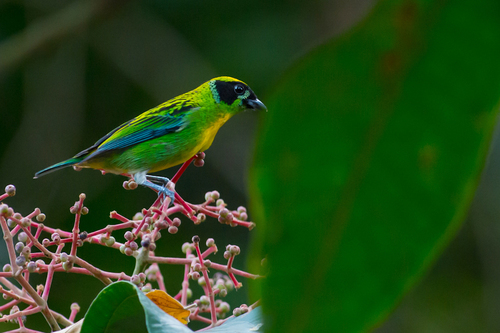
Green-and-gold Tanager
Tangara schrankii
Draped in iridescent emerald and sun-drenched gold, the Green-and-gold Tanager is a high-energy gem of the Amazonian canopy. Watching these social birds dart through the leaves is a masterclass in tropical beauty and agility.
Quick Identification
Size
Length 12-13 cm (4.7-5.1 in); weight approximately 15-22 g (0.5-0.8 oz)
Colors
Luminous emerald green upperparts with black speckling; vibrant golden-yellow belly and crown; distinctive black mask and forehead; orange-yellow rump.
Key Features
- Luminous emerald green plumage with fine black spotting on the back
- Bright golden-yellow midsection and crown
- Black facial mask extending through the eye
- Small, active songbird with a short, pointed bill
When You’ll See Them
Geographic range
Where Does the Green-and-gold Tanager Live?
Native to the lush interior of South America, the Green-and-gold Tanager is a jewel of the Western Amazon Basin. Its core range spans across the lowland forests of eastern Ecuador, Peru, and northern Bolivia, extending eastward into the vast Amazonian regions of Brazil and southern Colombia. These birds are permanent residents of the tropical humid zones, staying within the dense canopy year-round rather than migrating.
Basemap © OpenStreetMap contributors
Behavior
The Green-and-gold Tanager is a high-energy socialite of the tropical canopy. They are rarely seen alone, almost always traveling in small groups or as core members of mixed-species foraging flocks. You will often find them moving alongside other tanagers, honeycreepers, and flycatchers as they navigate the mid-to-upper levels of the forest in search of food.
Their foraging style is particularly acrobatic; they are known for 'leaf-gleaning,' where they hop along branches and frequently hang upside down to inspect the undersides of leaves for hidden insects. While they are not particularly shy around humans, their preference for the high canopy makes them a challenge to spot without binoculars or well-placed cameras. They communicate with high-pitched 'tsit' calls that help keep the flock together in the dense foliage.
EverydayEarth exclusive
Camera Tips
Capturing the Green-and-gold Tanager requires thinking vertically. Because these birds spend the vast majority of their time in the mid-to-upper canopy, a camera placed at eye level in a backyard clearing will likely miss them. If you have a property with tall trees, consider mounting your AI-powered camera on a high platform or a second-story balcony that looks directly into the tree line. They are particularly attracted to fruiting trees such as Miconia or Ficus, so positioning your lens near a ripening cluster of berries is your best bet for a clear shot.
Lighting is a major challenge in the Amazonian rainforest. The deep shade of the canopy can make these birds look dark or muddy. To bring out the 'gold' in their name, try to angle your camera so it captures the dappled morning sunlight. Use a fast shutter speed setting if your camera allows it; these birds are restless and move with quick, jerky motions that can cause motion blur in lower light settings.
Water is another powerful lure. While they stay high in the trees, they will occasionally descend to canopy-level water traps (like bromeliads) or elevated bird baths. A heated or dripping water feature placed on an elevated deck can entice them down from the highest branches. Because they travel in flocks, once one bird lands, several more usually follow, providing multiple opportunities for the AI to trigger and capture the perfect iridescent portrait.
Similar Species
Species that look similar or are commonly confused with Green-and-gold Tanager.
Frequently Asked Questions
Record Green-and-gold Tanager at your habitat
Connect a camera to start building your own species record — AI identifies every visitor automatically.