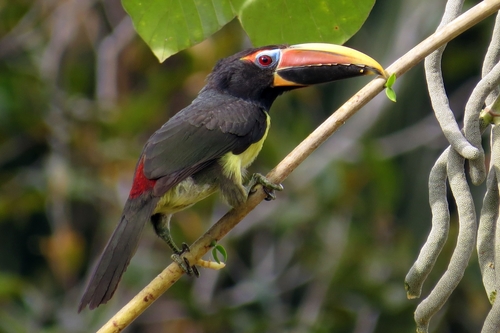
Green Aracari
Pteroglossus viridis
Meet the Green Aracari, the social and acrobatic 'mini-toucan' of the Amazonian canopy. With its vibrant yellow belly and multi-colored bill, this bird brings a splash of tropical brilliance to any backyard forest edge.
Quick Identification
Size
Length: 30–40 cm (12–16 in); Weight: 110–160 g (3.9–5.6 oz)
Colors
Dark forest green back and wings; bright yellow underparts; red rump. Males have black heads and necks, while females have maroon or chestnut heads.
Key Features
- Distinctive sexual dimorphism (male black head vs female maroon head)
- Multi-colored serrated bill with maroon, yellow, and blue-black tones
- Smallest aracari species in its native range
- Bright yellow belly and vibrant red rump
When You’ll See Them
Geographic range
Where Does the Green Aracari Live?
The Green Aracari is a signature resident of the lush tropical regions of northeastern South America, specifically within the Guiana Shield and the northeastern Amazon Basin. Its native range spans across Guyana, Suriname, and French Guiana, reaching into southeastern Venezuela and the northern states of Brazil. These birds are lowland specialists, thriving in the dense, humid rainforests where fruit-bearing trees are abundant and year-round.
Basemap © OpenStreetMap contributors
Behavior
Green Aracaris are highly social birds, often moving through the tropical canopy in small, tight-knit groups of three to twelve individuals. They are acrobatic foragers, hopping through branches with surprising agility as they seek out seasonal fruits. Unlike many other birds, they are known for communal sleeping; several adults will often pile into a single tree cavity at night, neatly tucking their long tails over their backs to fit into the tight space.
While predominantly fruit-eaters, they are opportunistic and will supplement their diet with insects or small vertebrates during the breeding season to gain extra protein. They are generally less wary of humans than the larger toucans but remain primarily canopy-dwellers, making them a rewarding sight for backyard observers who live near forest edges or maintain high-altitude garden platforms.
EverydayEarth exclusive
Camera Tips
To capture the Green Aracari on an AI camera, you must think vertically. Since these birds are strictly arboreal, mounting your camera at a height of at least 10–15 feet is essential. If you have a balcony or a high deck overlooking a wooded area, this is the perfect location. Angle the lens slightly downward toward a sturdy, horizontal branch that they might use as a landing pad before moving into thicker foliage.
If you are within their native range, a high-platform feeder is the best way to bring them into camera range. Use large chunks of fresh tropical fruit like papaya, bananas, or melon as a lure. Avoid small seeds, which they largely ignore. Because they are social, your camera's trigger may be set off by multiple birds at once; use a wide-angle lens setting to capture the full group interaction, which is often more interesting than a single bird.
Lighting is key for this species. Their bright yellow chests can easily become overexposed in the harsh midday sun. Set your camera to capture high-quality video or bursts during the early morning hours (just after sunrise) when the light is soft. This will help preserve the intricate colors of their multi-hued bill and the subtle distinction between the male's black head and the female's maroon plumage.
Similar Species
Species that look similar or are commonly confused with Green Aracari.
Frequently Asked Questions
Record Green Aracari at your habitat
Connect a camera to start building your own species record — AI identifies every visitor automatically.