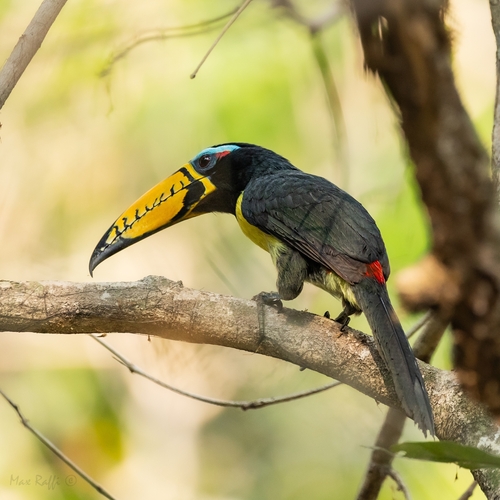
Lettered Aracari
Pteroglossus inscriptus
Admired for the cryptic, ink-like markings on its bill, the Lettered Aracari is the smallest and most social of the Amazonian toucans. This vibrant forest-dweller brings a splash of yellow and green to the canopy, traveling in tight-knit family groups.
Quick Identification
Size
29–33 cm (11.5–13 inches) long; 100–155 grams (3.5–5.5 oz)
Colors
Dark olive-green back and wings, bright yellow breast with a narrow black band. Males have a black crown and throat; females have a chestnut-brown throat.
Key Features
- Yellow bill with vertical black 'lettering' along the upper edge
- Thin, dark horizontal band or speckling on a yellow belly
- Bare blue or turquoise skin around the eyes
- Smallest of the aracari species
When You’ll See Them
Geographic range
Where Does the Lettered Aracari Live?
The Lettered Aracari is a resident of the lush South American tropics, primarily centered within the massive Amazon Basin. Its native range extends across northern and central Brazil, stretching westward into the tropical lowlands of Peru, Ecuador, and southern Colombia. It is also frequently spotted in the northern reaches of Bolivia, thriving wherever dense riverine forests provide ample fruit and nesting sites.
Basemap © OpenStreetMap contributors
Behavior
The Lettered Aracari is a highly social and energetic bird, typically traveling in small, noisy groups of three to twelve individuals. Unlike their larger toucan cousins, they are incredibly agile in flight, darting through the mid-to-upper canopy with rapid wingbeats followed by short glides. They are known for their communal nature, often sharing roosting cavities in hollow trees with several members of their flock to stay warm and protected at night.
These birds are vocal and communicative, using a series of dry, rhythmic 'tik-tik-tik' calls to keep the group together as they forage. While they can be shy in the deep forest, they are increasingly seen near human settlements and eco-lodges where fruit-bearing trees are present. They are intelligent and inquisitive, often investigating new objects or sounds in their territory with a characteristic tilt of the head.
EverydayEarth exclusive
Camera Tips
To capture the Lettered Aracari on camera, height is your most important factor. These are canopy-dwelling birds that rarely descend to the ground. If you are in their range, mount your camera at least 10 to 15 feet high, ideally overlooking an elevated feeding platform or a known fruiting tree like a palm or a wild fig. Angling the camera slightly downward from a higher branch can provide a stunning perspective of their colorful plumage and unique beak markings.
Because they are highly social, if you see one on your monitor, there are likely several more nearby. Set your camera to 'Burst Mode' or high-speed photo capture. They move their heads quickly while eating, and a fast shutter speed (at least 1/500s if your camera allows manual settings) is essential to prevent the 'ink' markings on the bill from blurring.
Luring Lettered Aracaris is most effective with fresh tropical fruit. Papaya, halved bananas, and melons are irresistible to them. Place the bait on a steady, flat branch or a wooden platform rather than a swinging feeder, as they prefer a stable perch while manipulating fruit with their large bills. If you use a birdbath, ensure it is also elevated; they are much more likely to visit a water source that keeps them safely above the forest floor.
Morning is the 'golden hour' for this species. They are most active and vocal just after sunrise as they move from their roosting holes to find their first meal. Position your camera to face away from the rising sun to avoid lens flare and capture the true vibrancy of their yellow and green feathers.
Similar Species
Species that look similar or are commonly confused with Lettered Aracari.
Frequently Asked Questions
Record Lettered Aracari at your habitat
Connect a camera to start building your own species record — AI identifies every visitor automatically.