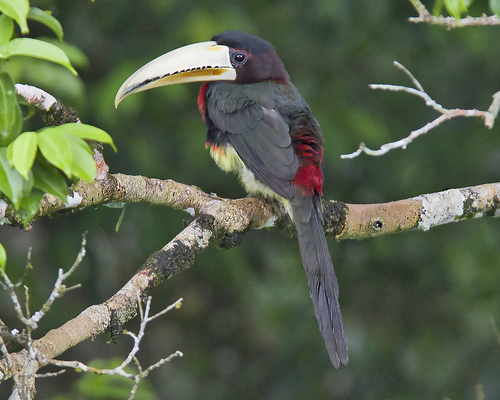
Ivory-billed Aracari
Pteroglossus azara
Boasting a stunning cream-colored beak and a bold red-banded chest, the Ivory-billed Aracari is a social and energetic icon of the Amazonian canopy. These small toucans travel in tight-knit family groups, bringing a splash of prehistoric beauty to the tropical rainforest.
Quick Identification
Size
Length: 36–45 cm (14–18 in); Weight: 120–160 g (4.2–5.6 oz)
Colors
Upper mandible is ivory to cream-colored; yellow underparts with a prominent red horizontal band; dark green back and wings; red rump; males have black heads while females have chestnut-brown heads.
Key Features
- Pale ivory-white upper bill with a dark culmen ridge
- Wide red horizontal band across a bright yellow belly
- Deep forest-green upperparts with a contrasting scarlet rump
- Males feature jet-black heads while females show rich chestnut-brown plumage on the head and throat
When You’ll See Them
Geographic range
Where Does the Ivory-billed Aracari Live?
Native to the heart of the South American continent, the Ivory-billed Aracari is a quintessential species of the Amazon Basin. Its range is centered in the tropical lowlands of northern and western Brazil, extending into the Amazonian regions of southern Venezuela, southeastern Colombia, eastern Ecuador, and eastern Peru. Unlike many migratory species, these birds are permanent residents of these humid tropical forests, rarely venturing far from the dense canopy and fruiting trees that define their home.
Basemap © OpenStreetMap contributors
Behavior
The Ivory-billed Aracari is a highly social member of the toucan family, typically found moving through the forest canopy in small, active groups of 3 to 12 individuals. These groups are often family units that forage, travel, and even sleep together. They are known for their 'communal roosting' habit, where several birds will squeeze into a single tree cavity—often an abandoned woodpecker hole—folding their long tails over their backs to save space.
In the wild, they are agile and somewhat acrobatic foragers, hopping through branches to reach ripe fruit. While they are primarily forest-dwellers, they are curious and can be seen at the edges of clearings or along riverbanks. They communicate with a variety of high-pitched, squeaky vocalizations that sound like 'teee-rit' or sharp 'ptit' notes, which help keep the flock together as they move through dense foliage.
EverydayEarth exclusive
Camera Tips
To capture the Ivory-billed Aracari on camera, you must think vertically. These are canopy-dwelling birds that rarely descend to the ground. If you are setting up a trail camera on a property near the Amazonian forest, aim for a 'canopy bridge' or a high branch overlooking a known fruiting tree, such as a Ficus or a fruiting palm. Using a climbing harness or a long pole to mount cameras 5–10 meters high significantly increases your chances of a clear shot.
Baiting is highly effective for aracaris if done correctly. They are particularly attracted to platforms stocked with native fruits like papaya, bananas, or halved melons. Place your camera 2–3 meters away from the bait station, ensuring the ivory bill is in focus, as the light-colored beak can sometimes 'blow out' or overexpose in direct sunlight. Using a camera with adjustable exposure or high dynamic range (HDR) settings can help preserve the detail in the bill.
Because these birds move in groups, set your camera to 'Burst Mode' or 'Photo + Video.' When one aracari lands, others are almost certain to follow. A 30-second video clip often captures the fascinating social dynamics, such as bill-fencing or communal feeding, which a single still photo might miss. Early morning light provides the best color saturation for their yellow and red feathers, so ensure your camera is active by dawn.
Finally, consider the humidity of the tropical environment. Use moisture-wicking silica gel packets inside your camera housing to prevent lens fogging, which is the number one cause of ruined footage in the aracari's habitat. Position the camera facing North or South to avoid the harsh glare of the tropical sun, which can trigger the PIR sensor unnecessarily and wash out the bird's vibrant colors.
Similar Species
Species that look similar or are commonly confused with Ivory-billed Aracari.
Chestnut-eared Aracari
Larger with a darker, serrated-looking bill and distinct chestnut patches on the sides of the head.
Many-banded Aracari
Features multiple blackish-red horizontal bands on the underparts rather than a single red band, and a darker upper mandible.
Green Aracari
Found further north/east in the Guianas; lacks the broad red belly band and has a more complex multi-colored bill pattern.
Frequently Asked Questions
Record Ivory-billed Aracari at your habitat
Connect a camera to start building your own species record — AI identifies every visitor automatically.