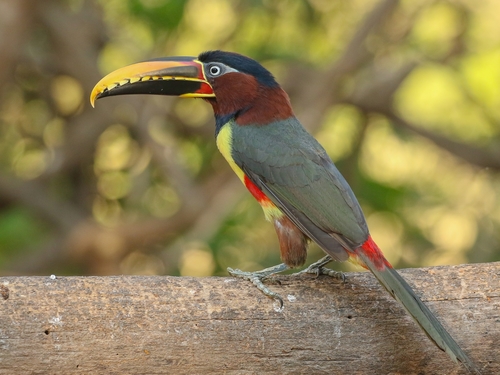
Chestnut-eared Aracari
Pteroglossus castanotis
A social and striking member of the toucan family, the Chestnut-eared Aracari is famous for its vibrant yellow breast and namesake chestnut ear patches. Watch these colorful acrobats travel in lively groups through the South American canopy.
Quick Identification
Size
Total length of 43–46 cm (17–18 inches); weight typically ranges from 230 to 310 grams (8.1–10.9 oz).
Colors
Glossy black upperparts with a dark green tint; yellow underparts featuring a bold red horizontal band; distinctive chestnut-brown patch on the ear and nape; bill is multi-colored with yellow, black, and ivory tones.
Key Features
- Broad red band across a bright yellow belly
- Large, serrated bill with a prominent yellow 'saw-tooth' pattern
- Rich chestnut patch covering the ear area
- Creamy-white to pale yellow eyes with dark pupils
When You’ll See Them
Geographic range
Where Does the Chestnut-eared Aracari Live?
Native to the heart of South America, the Chestnut-eared Aracari occupies a vast territory stretching from the eastern Andean foothills to the Atlantic coast. Its core populations are found throughout the southern Amazon Basin, encompassing much of central and southwestern Brazil, eastern Bolivia, and the forested regions of Paraguay. It is also a regular resident in northern Argentina and extends northward into the tropical lowlands of Peru, Ecuador, and southeastern Colombia.
Basemap © OpenStreetMap contributors
Behavior
The Chestnut-eared Aracari is a highly social and vocal member of the toucan family. They are rarely seen alone, typically moving through the canopy in tight-knit groups of 6 to 12 individuals. These groups are remarkably coordinated, often following a 'follow-the-leader' flight pattern as they move from one fruiting tree to the next. Unlike many other birds, they are known to share roosting cavities in hollow trees, where several adults may pile in together to sleep.
While they appear charismatic and playful, these birds are efficient foragers with a complex social structure. They spend much of their day hopping through branches using their oversized bills to reach fruit that would be inaccessible to heavier birds. In suburban settings near forest edges, they can become quite bold, visiting garden bird feeders or fruiting ornamental trees, though they remain wary of ground-level threats.
EverydayEarth exclusive
Camera Tips
To capture the Chestnut-eared Aracari, height is your greatest ally. Since these are canopy-dwelling birds, mounting your AI camera 10 to 15 feet up in a tree—ideally overlooking a known fruiting tree like a palm or fig—will yield much better results than a ground-level setup. If you are in a suburban area, place the camera near a high-platform feeder or a water basin mounted on a sturdy branch. They are particularly fond of water and will visit elevated birdbaths for a midday drink and splash.
For baiting, fresh tropical fruits like papaya, bananas, or halved melons are irresistible to these birds. Ensure the bait is secured to a platform or branch so they can't fly off with the entire piece. Because they travel in groups, set your camera to 'Burst Mode' or high-frequency capture. When one Aracari lands, others are almost certain to follow within seconds, and the social interaction—often including beak-fencing or food-sharing—makes for the best footage.
Lighting is crucial for bringing out the iridescent blacks and vibrant yellows of their plumage. Position your camera facing north or south to avoid the harsh backlighting of the tropical sun. Early morning (just after sunrise) provides the softest light and coincides with their first major feeding bout of the day. If you're using a trail camera, a fast trigger speed is essential, as these birds move with surprising agility despite their large bills.
Similar Species
Species that look similar or are commonly confused with Chestnut-eared Aracari.
Black-necked Aracari
Lacks the chestnut ear patch and has a thinner, less vibrant red band on the belly.
Many-banded Aracari
Distinguished by two black bands across the chest and belly rather than one red band.
Lettered Aracari
Much smaller with a distinctive 'letter-like' black marking pattern on the upper mandible.
Frequently Asked Questions
Record Chestnut-eared Aracari at your habitat
Connect a camera to start building your own species record — AI identifies every visitor automatically.