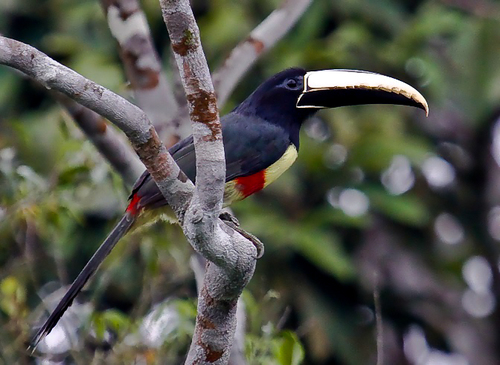
Black-necked Aracari
Pteroglossus aracari
With its striking ivory bill and bold crimson belly stripe, the Black-necked Aracari is a social superstar of the South American canopy. These playful toucans travel in tight-knit troops, bringing color and character to every forest edge they visit.
Quick Identification
Size
35-45 cm (14-18 inches) in length; 175-310 g (6.2-10.9 oz)
Colors
Solid black head and neck; ivory-white upper mandible with a black ridge; bright yellow underparts with a single broad red band; dark forest-green back and tail.
Key Features
- Distinctive red horizontal band across a yellow belly
- Ivory-white upper bill with a black stripe along the top
- Solid black head and throat without lighter patches
- Social behavior, often seen in groups of 3 to 12
When You’ll See Them
Geographic range
Where Does the Black-necked Aracari Live?
The Black-necked Aracari is a vibrant resident of South America, primarily concentrated in the northeastern portion of the continent. Its native territory spans the vast lowland forests of Brazil, extending through the Guianas—French Guiana, Guyana, and Suriname—and into the eastern reaches of Venezuela. These birds are lowland specialists, thriving in the humid tropical zones where forest cover remains contiguous and fruit is abundant year-round.
Basemap © OpenStreetMap contributors
Behavior
Black-necked Aracaris are highly social and energetic members of the toucan family. They are rarely seen alone, instead traveling in small, tight-knit troops that move through the canopy with a characteristic follow-the-leader flight pattern. Within these groups, they are remarkably vocal and playful, often engaging in mutual preening or 'bill-fencing'—a behavior where two birds tap their bills together to establish social hierarchy or strengthen pair bonds.
These birds are known for their intelligence and opportunistic nature. While primarily fruit-eaters, they are active foragers that will investigate every nook and cranny of the forest. Interestingly, they are communal nesters; several adults may sleep in the same tree cavity at night, often folding their long tails over their backs to save space. While they are wary of predators, they can become quite bold around reliable food sources, making them a delight for patient observers and backyard enthusiasts in their native range.
EverydayEarth exclusive
Camera Tips
To capture high-quality footage of Black-necked Aracaris, camera placement is everything. These are canopy-dwelling birds that rarely descend to the ground except for a quick bath. If you have tall trees, consider mounting your AI camera at least 10 to 15 feet high, or positioning it on a balcony that overlooks the mid-canopy layer. They are highly attracted to fruiting trees like palms, so aim your lens at clusters of ripening fruit where they are likely to land and linger.
If you are using a backyard feeding station, platform feeders are superior to hanging ones for this species. Stock the feeder with large chunks of papaya, mango, or banana. Because these birds travel in groups, a 'Burst Mode' setting is essential; the first bird to arrive is usually a scout, and the rest of the troop will follow seconds later. Using video mode (20-30 seconds) is even better for capturing their social interactions, as you might catch them feeding each other or bill-fencing on the camera perch.
Pay close attention to lighting. The deep black feathers of the head and the dark green of the back can easily 'wash out' or look like a featureless silhouette in bright midday sun. Position your camera so the sun is behind it, illuminating the bird's front. This will ensure the AI can clearly see the ivory bill and the red belly band, which are key for successful species identification. Early morning light provides the best color saturation for their vibrant plumage.
Similar Species
Species that look similar or are commonly confused with Black-necked Aracari.
Chestnut-eared Aracari
Features a large chestnut-colored patch behind the eye and a dark spot in the middle of the red belly band.
Green Aracari
Smaller with a more complex multi-colored bill pattern and lacks the solid red band across the belly.
Many-banded Aracari
Easily distinguished by having multiple dark bands across the chest and belly rather than a single red one.
Frequently Asked Questions
Record Black-necked Aracari at your habitat
Connect a camera to start building your own species record — AI identifies every visitor automatically.