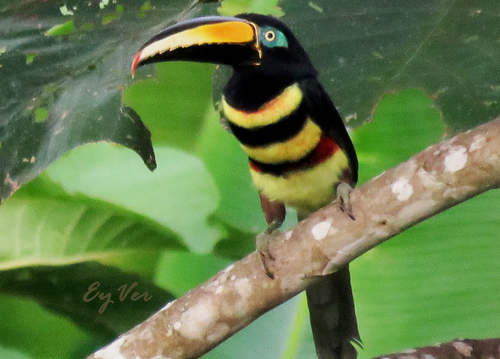
Many-banded Aracari
Pteroglossus pluricinctus
A social and striking member of the toucan family, the Many-banded Aracari is famous for its double-banded belly and its playful group travels through the Amazonian canopy.
Quick Identification
Size
43–46 cm (17–18 in) in length; weighs 215–300 g (7.6–10.6 oz)
Colors
Upperparts are dark olive-green with a red rump; underparts are yellow with two distinct black horizontal bands; bill features a mix of ivory, black, and orange-yellow with a serrated appearance.
Key Features
- Two prominent black horizontal bands on the yellow breast and belly
- Large ivory and black bill with a serrated 'toothed' pattern
- Bright red patch on the lower back/rump
- Dark chestnut-brown head and throat
When You’ll See Them
Geographic range
Where Does the Many-banded Aracari Live?
The Many-banded Aracari is a signature species of the Upper Amazon Basin in South America. Its native range is concentrated in the northwestern portion of the continent, covering vast areas of northwestern Brazil, southern Venezuela, eastern Colombia, eastern Ecuador, and northern Peru. This species is a true tropical specialist, thriving in the dense, moisture-rich environments of the Amazonian lowlands.
Basemap © OpenStreetMap contributors
Behavior
These birds are communal nesters and roost together in hollow tree cavities, often those abandoned by large woodpeckers. Within their groups, they exhibit playful behaviors and vocalize frequently with rhythmic, high-pitched 'twe-ee-at' calls. While they are bold when foraging in groups, they remain wary of larger predators and will quickly retreat into dense foliage if a hawk or eagle is spotted.
EverydayEarth exclusive
Camera Tips
To successfully capture the Many-banded Aracari on camera, you must think vertically. These birds rarely descend to the ground, so mounting your camera at a height of 10 to 20 feet is ideal. Focus on 'hotspots' like fruiting fig trees or palms. If you can safely secure your camera to a branch overlooking a cluster of ripening fruit, you are almost guaranteed high-quality footage as the birds spend considerable time manipulating fruit with their large bills.
In a backyard or lodge setting near the forest edge, fruit platforms are highly effective. Use overripe bananas, papayas, or melons to entice them. Position the camera roughly 5 to 8 feet from the platform to capture the fine details of their serrated bills and double-banded plumage. Because they are social, expect multiple birds to arrive at once; use a wider-angle lens setting if possible to capture the group dynamics and 'pecking order' at the feeder.
Lighting is a major challenge in the dense Amazonian canopy. Try to position your camera so it faces away from the morning sun to avoid silhouetting. Since these birds are fast movers, use a high shutter speed or a camera with a fast trigger interval. Setting your device to record short 10-15 second video clips is often better than still photos, as it captures their unique 'bobbing' head movements and vocalizations, which are key for positive identification.
Similar Species
Species that look similar or are commonly confused with Many-banded Aracari.
Chestnut-eared Aracari
It has only one black band on the belly and a prominent chestnut-colored patch behind the eye.
Ivory-billed Aracari
Smaller in size with a much lighter, cream-colored bill and lacks the distinct double black bands on the belly.
Collared Aracari
Features a single black spot or partial band on the breast rather than two full horizontal bands.
Frequently Asked Questions
Record Many-banded Aracari at your habitat
Connect a camera to start building your own species record — AI identifies every visitor automatically.