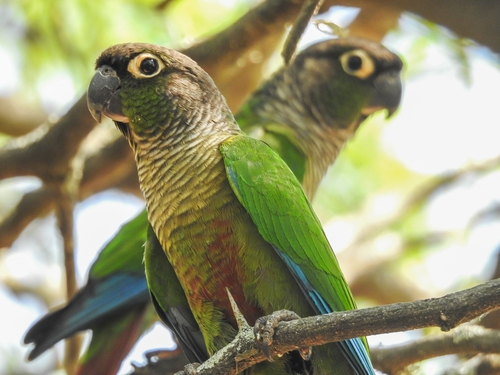
Green-cheeked Parakeet
Pyrrhura molinae
A splash of vibrant green and maroon, the Green-cheeked Parakeet is one of South America's most playful and social forest dwellers. Discover how to identify and capture these acrobatic parrots in their native woodland habitats.
Quick Identification
Size
26 cm (10.2 inches) in length; wingspan approx. 13-15 cm per wing; weight 60-80 grams (2.1-2.8 oz)
Colors
Green body, dark grey or brown crown, white eye-rings, blue primary wing feathers, maroon tail, and grey scalloped feathers on the breast. Sexes are monomorphic.
Key Features
- Maroon-red tail feathers
- Distinct white eye-ring against a dark crown
- Scalloped grey-to-yellow pattern on the chest
- Bright green cheeks and blue flight feathers
When You’ll See Them
Geographic range
Where Does the Green-cheeked Parakeet Live?
The Green-cheeked Parakeet is native to the heart of South America, inhabiting the interior regions where forest meets scrubland. Its core range spans across eastern Bolivia, southwestern Brazil in the Mato Grosso region, northwestern Paraguay, and northern Argentina. Within these territories, they thrive at various elevations and are frequently spotted near rural settlements where forest edges provide both protection and a steady source of seasonal fruit.
Basemap © OpenStreetMap contributors
Behavior
Green-cheeked Parakeets are highly social and energetic birds, typically observed in noisy flocks of 10 to 30 individuals. In the wild, they are known for their playful and inquisitive nature, often seen performing acrobatics like hanging upside down from branches while foraging for food. Unlike many larger parrots, they are relatively quiet when resting but become quite vocal and communicative during flight or when alerted to potential predators.
While they can be shy around humans in dense forest environments, they have adapted remarkably well to suburban fringes and rural farms in parts of South America. Their social structure is complex; they form strong pair bonds and communicate through a series of high-pitched chirps and squawks. In flight, their rapid wing beats and sudden changes in direction make them a dazzling sight against the forest canopy.
EverydayEarth exclusive
Camera Tips
To capture the vibrant colors of the Green-cheeked Parakeet, place your camera near known food sources like fruiting trees (especially wild figs) or water stations. These birds are frequent bathers and highly social, so a shallow, elevated birdbath in a sunny but sheltered spot is an ideal location. Mount your camera at eye level—roughly 5 to 8 feet high—angled slightly downward to catch the intricate scalloping on their chests as they land and interact.
Because these parakeets are incredibly fast flyers and move with sudden, jerky motions, use a high-speed trigger setting and a fast shutter speed if your camera allows. If you are in their native range, a bird feeder stocked with sunflower seeds, safflower, or fresh fruit like apples and oranges can lure them into the frame. Ensure the camera is positioned to avoid direct midday glare, as the iridescent blue in their wings can cause overexposure; morning or late afternoon light provides the best saturation for their green and maroon plumage.
Consistency is key for these birds. They often follow the same foraging routes daily. If you spot a flock in the morning, set your camera to record short video clips rather than just stills. This allows you to capture their fascinating social interactions, mutual preening, and unique vocalizations. Avoid placing cameras in deep, dark shade, as their 'green-on-green' camouflage makes them difficult for AI sensors to trigger without adequate lighting and contrast.
Similar Species
Species that look similar or are commonly confused with Green-cheeked Parakeet.
Frequently Asked Questions
Record Green-cheeked Parakeet at your habitat
Connect a camera to start building your own species record — AI identifies every visitor automatically.