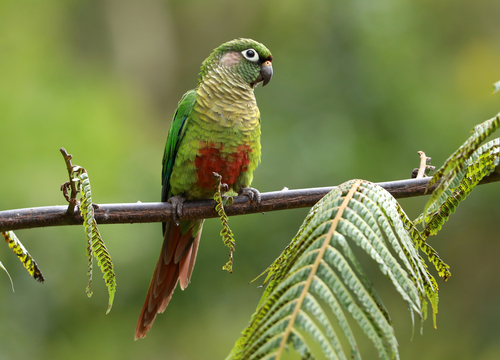
Maroon-bellied Parakeet
Pyrrhura frontalis
Meet the charming Maroon-bellied Parakeet, a social acrobat of the South American canopy. Known for its playful personality and distinctive scalloped plumage, this resilient parrot is a frequent and colorful visitor to backyard gardens.
Quick Identification
Size
25–28 cm (10–11 in) in length; wingspan of approximately 35 cm (14 in); weight ranges from 72–94g (2.5–3.3 oz)
Colors
Primary green plumage with a distinctive maroon patch on the lower belly; yellowish-green 'scalloped' feathers on the breast; reddish-brown tail and brownish-maroon ear coverts. Males and females are identical in appearance.
Key Features
- Distinctive maroon or reddish patch on the belly
- Yellowish-green 'scaly' pattern on the breast and neck
- Reddish-brown color on the underside of the tail
- Brownish-maroon ear patches and a thin maroon line on the forehead
When You’ll See Them
Geographic range
Where Does the Maroon-bellied Parakeet Live?
The Maroon-bellied Parakeet is native to South America, where it thrives in the diverse ecosystems of the southeastern portion of the continent. Its primary range encompasses southeastern Brazil, extending through eastern Paraguay and Uruguay into northeastern Argentina. Because of its adaptability, it is one of the most common parrots in its region, successfully transitioning from dense Atlantic forests to the leafy suburbs of major metropolitan areas.
Basemap © OpenStreetMap contributors
Behavior
The Maroon-bellied Parakeet is an exceptionally social and gregarious bird, typically traveling in noisy flocks of 6 to 12 individuals, though larger groups may congregate where food is abundant. They are masters of the canopy, moving with agility through dense foliage as they forage for food. While they can be shy in deep forests, they have become remarkably bold in suburban environments, often visiting bird feeders and garden fruit trees where they announce their arrival with high-pitched, metallic shrieks.
These parakeets are known for their playful and intelligent nature. In the wild, they exhibit complex social interactions, including mutual preening and synchronized flight. During the heat of the day, they often fall silent and rest in the shade of dense trees, making them surprisingly difficult to spot despite their bright colors. Their interaction with humans is generally peaceful, and they are well-regarded for their ability to adapt to urban green spaces and backyard habitats.
EverydayEarth exclusive
Camera Tips
To capture high-quality footage of Maroon-bellied Parakeets, position your camera near a reliable water source or a bird bath. These birds are frequent bathers and are most likely to remain stationary on the ground or a low pedestal during these sessions. Place the camera at a slight downward angle about 3 to 5 feet away from the water to capture the detail of their 'scaly' breast plumage and the maroon belly patch that gives them their name.
If you are using a feeder to attract them, offer sunflower seeds, pieces of apple, or native fruits. Because they are fast-moving and often land in groups, set your camera to a fast shutter speed or a high-frame-rate video mode. Using a 'burst' photo setting is highly recommended, as it allows you to capture the split-second moments when they flare their reddish tails or interact with other members of the flock.
Lighting is crucial for bringing out the vibrant greens and reds of their feathers. Try to place your camera in an area that receives bright, filtered morning light. Avoid direct midday sun, which can wash out the subtle transitions in their plumage. If your camera has a sensitivity setting, set it to high; these birds are wary and move quickly, so you want a trigger that captures them the moment they land on a branch or feeder.
Similar Species
Species that look similar or are commonly confused with Maroon-bellied Parakeet.
Frequently Asked Questions
Record Maroon-bellied Parakeet at your habitat
Connect a camera to start building your own species record — AI identifies every visitor automatically.