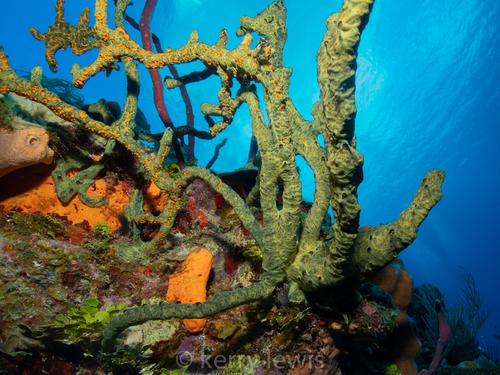
Green Finger Sponge
Iotrochota birotulata
A striking architect of the Caribbean reefs, the Green Finger Sponge is famous for its long, velvety branches and its curious habit of 'bleeding' purple ink. This resilient filter-feeder creates a vertical forest that provides shelter for a diverse community of tiny sea creatures.
Quick Identification
Size
Individual branches typically reach 20–100 cm (8–40 inches) in length and 1–3 cm (0.4–1.2 inches) in diameter.
Colors
Typically deep forest green to olive-black; notably turns dark purple or black when stressed, dying, or removed from water.
Key Features
- Long, slender, branching finger-like growth habit
- Surface covered in tiny, sharp-looking conical projections called conules
- Releases a staining purple dye when handled
- Tough and slightly elastic texture
When You’ll See Them
Geographic range
Where Does the Green Finger Sponge Live?
Native to the tropical Western Atlantic, the Green Finger Sponge is a quintessential inhabitant of the Caribbean basin. Its range is centered in the Caribbean Sea and extends northward through the Bahamas to the coastal waters of Florida. To the south, it is commonly found along the northern coast of South America, with established populations reaching as far as the tropical reefs of Brazil.
Basemap © OpenStreetMap contributors
Behavior
The Green Finger Sponge is a sessile marine invertebrate that spends its entire adult life anchored to the hard substrates of coral reefs or sandy lagoon floors. Despite its plant-like appearance, it is a complex animal that actively pumps seawater through its body. It uses a specialized system of internal chambers lined with whip-like cells called choanocytes to create a current, allowing it to filter out oxygen and microscopic food particles from the surrounding water.
This species is highly regarded for its chemical defenses; it produces secondary metabolites that make it unpalatable to many reef predators like parrotfish. It often functions as a 'miniature skyscraper' within the reef ecosystem, providing a physical anchor point for brittle stars, which wrap their arms around the sponge's branches, and a hunting ground for small gobies and snapping shrimp that hide among its conules.
EverydayEarth exclusive
Camera Tips
To capture the Green Finger Sponge with an underwater camera, stability is your most important asset. Because these sponges grow in areas with constant surge and current, use a weighted tripod or a fixed reef mount for your AI camera. Position the lens at a slight upward angle against the sunlight to capture the silhouette of the branches, or use a side-mounted video light to highlight the 'conules'—the tiny bumps on the sponge's skin—which provide excellent texture for high-definition sensors.
Since the sponge itself is stationary, the most compelling footage comes from the 'resident' wildlife. Program your AI camera to trigger on small movements. You will often catch brittle stars emerging from the base of the sponge at night or small cleaner shrimp traversing the branches. These sponges are also favorite 'perches' for small fish, so keeping a wide enough frame to see the entire branch structure will help you capture these social interactions.
Color correction is vital for this species. Because water filters out red light, a Green Finger Sponge can look like a grey smudge at depths below 10 feet. Use a red filter on your lens or ensure your camera’s white balance is set for 'underwater' mode to accurately record its vibrant forest-green color. If you are using a time-lapse setting, take a shot every 30 seconds during a tide change to see how the sponge branches sway and how the water clarity shifts as the sponge filters the surrounding area.
Similar Species
Species that look similar or are commonly confused with Green Finger Sponge.
Frequently Asked Questions
Record Green Finger Sponge at your habitat
Connect a camera to start building your own species record — AI identifies every visitor automatically.