Green Frog
Lithobates clamitans
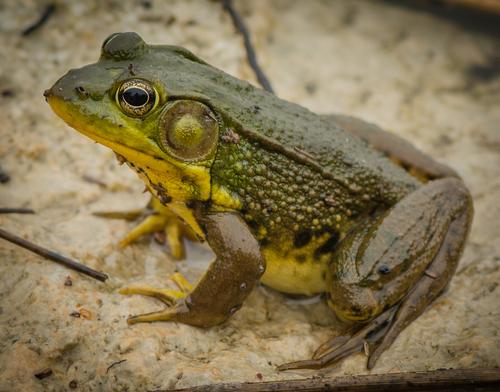
The Green Frog is the quintessential sound of a North American summer, known for its iconic banjo-like call and bold personality. These colorful residents are a delight for backyard pond owners and the perfect subjects for low-profile wildlife photography.
Quick Identification
Size
2 to 4 inches (5 to 10 cm) in length; weighs approximately 1 to 3 ounces (28 to 85 grams)
Colors
Varies from bright green to olive or bronze-brown; males feature a bright yellow throat during breeding season, while females have white throats
Key Features
- Dorsolateral ridges running from the eye down the back but ending before the groin
- Large, prominent eardrum (tympanum) located just behind the eye
- Smooth skin with occasional small bumps
- Distinctive 'banjo-pluck' advertisement call
When You’ll See Them
Behavior
Green Frogs are primarily solitary and highly territorial, often claiming a specific 'station' along the water's edge. Unlike many other frog species that are skittish and flee at the slightest vibration, Green Frogs are surprisingly bold and will often remain perfectly still as you approach, relying on their camouflage to stay hidden. They are classic sit-and-wait predators, spending hours perched on a lily pad or a muddy bank waiting for an unsuspecting insect to fly within range of their sticky tongue.
During the breeding season, which is one of the longest of any North American amphibian, males establish small territories and defend them vigorously from rivals using their iconic vocalizations. When threatened by a predator, they give a sharp, high-pitched squeak as they leap into the water, a behavior that often alerts observers to their presence before they are even seen. While they are mostly aquatic, they are known to move between bodies of water during heavy rainstorms.
EverydayEarth exclusive
Camera Tips
Capturing high-quality footage of a Green Frog requires a different strategy than filming mammals. Most trail cameras use Passive Infrared (PIR) sensors that trigger when they detect a change in heat. Since frogs are ectothermic (cold-blooded), they rarely trigger standard PIR sensors. To capture them successfully, switch your AI camera to 'Time Lapse' mode or 'Motion Detection' with high sensitivity if it utilizes pixel-change technology rather than just heat signatures. Setting your camera to take a photo or short video every 2 to 5 minutes during the twilight hours is a reliable way to catch them in action.
Placement is everything for these small amphibians. Position your camera just 4 to 6 inches above the ground or water level, aimed at a flat 'basking spot' such as a partially submerged log, a flat rock at the pond's edge, or a cluster of lily pads. A side-profile angle is best for identification, as it allows you to clearly see the dorsolateral ridges that distinguish them from Bullfrogs. If you are using a backyard camera, focus the lens on a high-traffic area of your pond where the frog frequently perches to hunt.
Lighting can be tricky because a Green Frog's wet skin is highly reflective. Standard infrared (IR) flashes often result in a 'blown out' white image where the frog's features are lost. If your camera has adjustable flash settings, turn the intensity down. Alternatively, placing a very dim, solar-powered LED light near the pond can provide enough ambient light for the camera to stay in 'day' mode longer, capturing the frog's beautiful green and bronze colors during the transition into night.
To guarantee a visit to your camera's field of view, create an irresistible hunting ground. Green Frogs are attracted to areas where insects congregate. Placing your camera near a low-intensity light source or a patch of flowering aquatic plants will draw in the flies and moths the frogs crave. If you provide a stable, flat stone just an inch above the water line in a quiet corner of your pond, a Green Frog will almost certainly claim it as its primary hunting station, giving you a predictable location for your lens.
Similar Species
Species that look similar or are commonly confused with Green Frog.
American Bullfrog
Bullfrogs are much larger and lack the dorsolateral ridges running down the back; their ridges only wrap around the ear.
Mink Frog
Found further north, Mink Frogs have a distinct musky odor when handled and their spots look more like mottling or leopard-like blotches.
Wood Frog
Wood Frogs are more terrestrial and can be identified by the dark 'robber's mask' across their eyes.
Frequently Asked Questions
Record Green Frog at your habitat
Connect a camera to start building your own species record — AI identifies every visitor automatically.