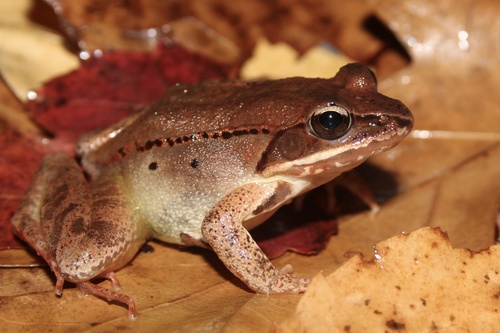
Wood Frog
Lithobates sylvaticus
The wood frog is a master of camouflage and a miracle of biology, capable of freezing solid during the winter. As the very first amphibians to emerge in the spring, their duck-like quacks are the true heralds of a new season.
Quick Identification
Size
1.4 to 3.2 inches (3.5 to 8.2 cm); roughly the size of a large strawberry or a human thumb.
Colors
Typically shades of tan, brown, or rust-red; distinctive dark brown or black 'robber's mask' extending through the eye and over the eardrum.
Key Features
- Dark brown 'mask' across the eyes
- Prominent ridges running down each side of the back
- White line along the upper lip
- Duck-like 'quacking' mating call
When You’ll See Them
Behavior
During the spring, these frogs are explosive breeders. They migrate to vernal pools—temporary woodland ponds—in massive numbers for a very short window of time. The males produce a collective chorus that sounds more like a flock of quacking ducks than a typical frog croak. Once the breeding season ends, they are largely solitary and spend their time hopping through the damp forest floor, relying on their exceptional camouflage to disappear into the fallen leaves.
EverydayEarth exclusive
Camera Tips
To capture Wood Frogs on your backyard or trail camera, you must think low. These frogs spend their entire lives on the ground, so your camera should be positioned no more than 3 to 6 inches off the forest floor. A common mistake is mounting cameras at knee-height, which will completely miss these small amphibians. Aim your lens at a 'natural funnel,' such as a damp gap between two mossy logs or a clear path through thick leaf litter leading toward a water source. If you have a small backyard pond or a muddy depression that fills with rain, this is the gold mine for Wood Frog activity.
Because Wood Frogs are cold-blooded and relatively small, they may not always trigger a standard Passive Infrared (PIR) motion sensor. To maximize your chances, set your camera to 'Time-Lapse' mode during the 'Big Night'—the first warm, rainy night of spring when temperatures hit 40-50°F. Setting a 30-second or 1-minute interval during the evening and early morning hours of March and April will almost certainly catch them as they migrate toward breeding pools. If your camera has a 'High Sensitivity' motion setting, use it, as it will be more responsive to the slight heat difference of a moving frog.
You can 'stage' an area to make it more attractive for Wood Frog photos. They love moisture and cover, so placing a few large, flat pieces of bark or a 'toad house' (a ceramic pot turned sideways) in front of the camera can provide a resting spot where they might pause for a clear shot. Avoid using artificial bait; instead, focus on habitat. If you have a dry spell in spring, lightly misting the area in front of your camera with de-chlorinated water at sunset can create a 'micro-climate' that attracts them. For the best image quality, ensure your camera has a close-focus capability, as standard trail cams often have a minimum focus distance of 3-5 feet; placing the camera slightly further back and zooming in digitally later can prevent blurry 'blob' photos.
Similar Species
Species that look similar or are commonly confused with Wood Frog.
Northern Leopard Frog
Lacks the dark eye mask and features distinct, circular dark spots with light borders across its back and legs.
Spring Peeper
Much smaller (about 1 inch) and features a characteristic dark 'X' mark on its back instead of a mask.
Boreal Chorus Frog
Has three dark stripes down its back rather than the Wood Frog's solid tan or brown coloring and dorsolateral ridges.
Frequently Asked Questions
Record Wood Frog at your habitat
Connect a camera to start building your own species record — AI identifies every visitor automatically.