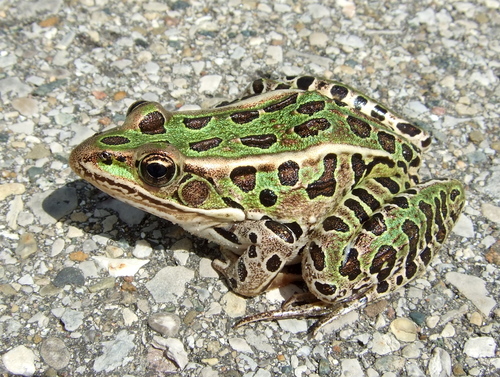
Northern Leopard Frog
Lithobates pipiens
With its striking leopard-like spots and incredible leaping power, the Northern Leopard Frog is a jewel of the North American wetlands. These 'meadow frogs' are as comfortable in your damp backyard grass as they are in the water.
Quick Identification
Size
5 to 11 cm (2 to 4.5 inches) in length; typically weighs between 20 and 50 grams (0.7 to 1.8 ounces).
Colors
Bright green, tan, or brown base color covered in large, dark, circular spots with pale borders. The underside is pearly white or cream. Males have swollen thumbs during breeding season.
Key Features
- Distinctive dark oval spots with light-colored halos
- Two prominent, pale ridges (dorsolateral folds) running from eyes to lower back
- Smooth, moist skin without the warts found on toads
- Large, powerful hind legs designed for long-distance jumping
When You’ll See Them
Behavior
Northern Leopard Frogs are often called 'meadow frogs' because of their tendency to wander far from open water during the summer months. While they rely on permanent water for breeding and overwintering, you are just as likely to encounter one in tall grass or a damp garden as you are at the pond's edge. They are master leapers, using their powerful hind legs to escape predators in a series of zig-zagging jumps that make them difficult to track.
These amphibians are primarily solitary outside of the spring breeding season. During the spring, males congregate in shallow wetlands to produce a unique 'snoring' call followed by several clicking sounds. They are sit-and-wait predators, remaining perfectly still until an unsuspecting insect crosses their path, at which point they strike with lightning speed using their sticky tongues. They are generally shy around humans, diving into water or deep grass at the first sign of a footstep.
EverydayEarth exclusive
Camera Tips
To capture high-quality footage of a Northern Leopard Frog, placement is everything. Since these frogs are low to the ground and often blend into the grass, you should mount your camera just a few inches off the ground. Angle the lens slightly downward to focus on a 'landing pad'—a flat rock or a patch of bare soil near the edge of a pond or a damp garden bed. This increases the likelihood of the AI triggering on the frog's distinct spotted pattern rather than moving vegetation.
Lighting and moisture are your best friends. These frogs are most active during humid evenings or immediately after a rainstorm. If your camera has adjustable sensitivity, set it to 'High' to ensure the relatively small motion of a frog triggers the recording. Because they are cold-blooded, traditional PIR (passive infrared) sensors might struggle to detect them against the ground temperature; using a camera with AI-powered pixel change detection or a short-interval time-lapse mode is much more effective for capturing amphibians.
Creating a 'micro-habitat' in front of your camera can lure them into view. A shallow dish of water or a consistently damp patch of mulch will attract both the frogs and the insects they hunt. Avoid using bright white-light flashes at night, as this can startle them and cause them to flee; instead, rely on infrared (IR) night vision for natural behavior. In the spring, placing the camera near the shallow, weedy margins of a pond will help you capture their fascinating breeding behaviors and unique 'snoring' vocalizations.
Similar Species
Species that look similar or are commonly confused with Northern Leopard Frog.
Pickerel Frog
Features square-shaped spots in rows and bright yellow/orange 'flash' colors on the inner thighs.
Wood Frog
Lacks the large spots and features a distinct dark brown 'robber's mask' across the eyes.
American Bullfrog
Much larger and lacks the distinctive dark spots and light-colored dorsolateral ridges.
Frequently Asked Questions
Record Northern Leopard Frog at your habitat
Connect a camera to start building your own species record — AI identifies every visitor automatically.