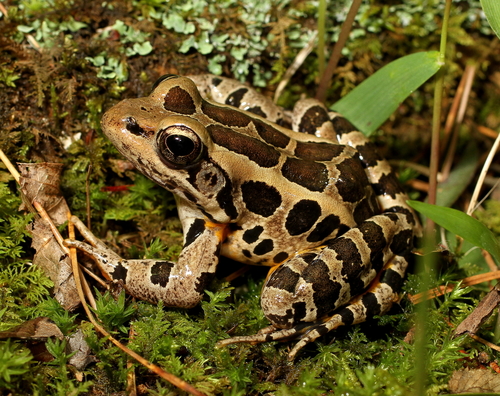
Pickerel Frog
Lithobates palustris
With its peculiar square spots and hidden flashes of yellow, the Pickerel Frog is the 'geometric beauty' of the amphibian world. Discover how to find this toxin-protected hopper in your own damp garden corners.
Quick Identification
Size
1.75 to 3 inches (4.5 to 7.5 cm); weighs roughly 0.5 to 1 ounce (15 to 28 g)
Colors
Tan, brown, or olive-green base with two rows of dark, rectangular chocolate-brown spots. The inner thighs feature a bright yellow or orange 'flash' color.
Key Features
- Two rows of 'hand-drawn' square or rectangular spots along the back
- Bright yellow or orange coloration on the inner surface of the hind legs
- Uninterrupted light-colored ridges (dorsolateral folds) extending from the eye to the lower back
When You’ll See Them
Behavior
The Pickerel Frog is a somewhat shy and secretive member of the leopard frog family, known primarily for its distinct, geometric markings and its unique chemical defense. Unlike many other frogs that rely solely on camouflage or speed, the Pickerel Frog produces a skin secretion that is toxic to many predators. This toxin is potent enough that placing a Pickerel Frog in a container with other frog species can often prove fatal to the others. Because of this, even snakes tend to give them a wide berth once they’ve had a bad experience.
These frogs are remarkably terrestrial compared to their cousins. While they return to the water to breed and stay near moist environments, it is not uncommon to find them wandering through tall grass, hayfields, or damp woodlands far from a permanent pond. They are skilled jumpers and will use their powerful hind legs to make several rapid, zig-zagging leaps toward the nearest cover if they feel threatened. During the breeding season, their call is a low, snore-like sound that lasts for about two seconds, often mistaken for a distant motor or a grumbling stomach.
EverydayEarth exclusive
Camera Tips
Capturing the Pickerel Frog on a backyard camera requires a strategy focused on micro-habitats. Because these frogs are small and remain close to the ground, your camera should be mounted no more than 4 to 6 inches above the soil. A downward-facing angle is best to capture the distinctive 'hand-drawn' square spots on their backs, which are their most identifying feature. If you place your camera on a standard tree mount at chest height, you will likely only catch blurry motion or miss them entirely.
To encourage them to pose for the camera, look for 'waystations' between water sources and hunting grounds. A flat, mossy rock or a piece of driftwood near a damp garden edge makes an excellent stage. These frogs are attracted to moisture, so placing your camera near a dripping garden hose or a small, shallow water dish can be very effective. Since they are primarily nocturnal, ensure your camera's infrared flash is optimized for close-range subjects to avoid 'white-out' photos where the frog’s skin reflects too much light.
One of the best 'lures' for a Pickerel Frog isn't food, but light. By placing a small, solar-powered garden light a few feet away from your camera's field of view, you will attract the nocturnal insects they hunt. The frog will often sit patiently in the shadows just outside the light's radius, waiting for an easy meal. This setup provides high-action opportunities for your camera's video mode.
Timing is critical for this species. Set your camera to its most sensitive PIR (motion) setting during the first warm rains of spring. Pickerel Frogs are most active when humidity is high. Using a camera with a fast trigger speed (0.3 seconds or less) is highly recommended, as they are explosive jumpers. If you are using video, set the clip length to at least 15 seconds to capture their stalking behavior or their unique, snoring vocalizations during the breeding months.
Similar Species
Species that look similar or are commonly confused with Pickerel Frog.
Frequently Asked Questions
Record Pickerel Frog at your habitat
Connect a camera to start building your own species record — AI identifies every visitor automatically.