Southern Leopard Frog
Lithobates sphenocephalus
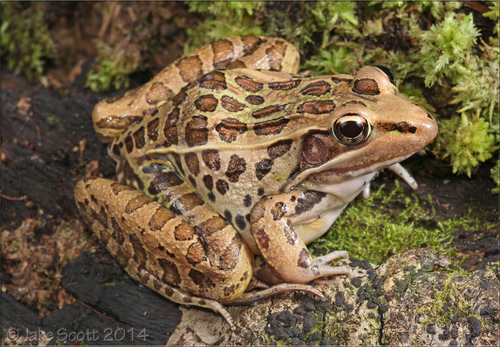
With its striking spotted pattern and athletic jumping ability, the Southern Leopard Frog is a backyard favorite. Look for the 'white bullseye' on its ear to identify this master of the wet meadow.
Quick Identification
Size
2 to 3.5 inches (5 to 9 cm) in length; females are generally larger than males.
Colors
Vibrant green to tan or brown base with dark, irregular circular spots; white belly; distinctive white spot in the center of the bronze or brown eardrum.
Key Features
- Distinct white spot in the center of the tympanum (eardrum)
- Prominent light-colored ridges (dorsolateral folds) extending from eyes to the groin
- Pointed snout compared to other similar frogs
- Long, powerful hind legs with dark banding
When You’ll See Them
Behavior
The Southern Leopard Frog is a high-energy amphibian known for its incredible leaping ability. When startled, it often emits a short, high-pitched squeak before diving into the water and zig-zagging to safety. Unlike many other aquatic frogs, this species is quite terrestrial during the summer months, frequently wandering far from permanent water sources into damp meadows or tall grass to forage.
These frogs are famous for their unique 'chuckle-like' call, which sounds like someone rubbing their thumb across a balloon followed by a series of guttural pulses. While primarily nocturnal, you may see them active during the day if the weather is overcast or rainy. They are solitary outside of the breeding season but can congregate in large numbers in shallow wetlands when it's time to mate.
EverydayEarth exclusive
Camera Tips
To capture the Southern Leopard Frog on your AI camera, the most critical factor is the 'frog-eye' perspective. Mount your camera no more than 4-6 inches off the ground. Aiming the lens parallel to the water’s edge or along the border of a damp garden bed is ideal, as these frogs use these 'corridors' to hunt. If your camera allows, use a macro or close-focus setting, as these are smaller subjects than your typical backyard mammal.
Because these frogs are most active at night, your camera’s infrared (IR) performance is vital. However, their moist skin is highly reflective, which can lead to 'blown-out' images where the frog looks like a white silhouette. If possible, position the camera so it isn't aiming directly at a reflective water surface, and try to place it 3-5 feet back from where you expect the frog to sit to allow the IR flash to diffuse naturally.
Trigger speed is your best friend with this species. Southern Leopard Frogs are explosive jumpers; a slow trigger will result in a photo of a disappearing hind leg. Set your camera to 'Burst Mode' or 'Photo + Video' to ensure you catch the moment they land or begin their call. High-sensitivity PIR settings are recommended because cold-blooded animals don't always trigger heat-based sensors as effectively as warm-blooded ones.
To attract them to a specific spot for the camera, you don't need traditional bait. Instead, use a low-voltage garden light or a solar-powered LED near your camera setup. The light will attract nocturnal insects like moths and beetles, creating a 'buffet' that will keep the Southern Leopard Frog stationary in front of your lens for an extended period. This is the most effective way to get clear, high-quality footage of their hunting behavior.
Similar Species
Species that look similar or are commonly confused with Southern Leopard Frog.
Frequently Asked Questions
Record Southern Leopard Frog at your habitat
Connect a camera to start building your own species record — AI identifies every visitor automatically.