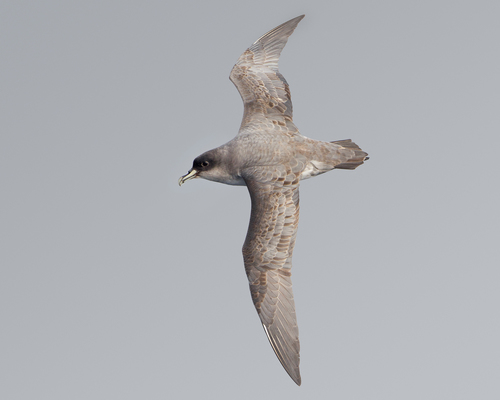
Grey Petrel
Procellaria cinerea
A champion of the Southern Ocean's stormy latitudes, the Grey Petrel is one of the few seabirds brave enough to breed during the harsh sub-Antarctic winter.
Quick Identification
Size
Length: 48 cm (19 in); Wingspan: 115–130 cm (45–51 in); Weight: 1–1.2 kg (2.2–2.6 lbs)
Colors
Ash-grey upperparts, pure white underparts, dark grey-brown underwings, and a pale yellowish-green bill with black markings.
Key Features
- Ash-grey upperparts contrasting with white belly
- Robust, pale bill with a dark tip
- Large, heavy-bodied appearance with long, pointed wings
When You’ll See Them
Geographic range
Where Does the Grey Petrel Live?
The Grey Petrel is a circumpolar resident of the Southern Hemisphere, making its home in the vast, cold waters between the 32nd and 58th parallels. It is most commonly found in the Southern Ocean, patrolling the high seas around Antarctica and reaching the southern coastlines of South America, South Africa, Australia, and New Zealand. Its primary breeding grounds are restricted to remote islands such as Tristan da Cunha, Gough, the Kerguelen Islands, and several of New Zealand’s sub-Antarctic outposts like Campbell and Antipodes Islands.
Basemap © OpenStreetMap contributors
Behavior
The Grey Petrel is a highly pelagic species, meaning it spends the vast majority of its life over the open ocean, often far from land. Unlike many of its relatives in the petrel family which are strictly nocturnal at their nesting sites, the Grey Petrel is frequently active during the day at sea. It is a powerful flyer, using a combination of gliding and flapping to traverse the windy Southern Ocean. It is also an accomplished diver, capable of plunging from the surface or performing pursuit-dives to depths of over 20 meters to catch prey.
Socially, these birds are colonial breeders, returning to remote sub-Antarctic islands during the autumn and winter—a timing that sets them apart from most other southern seabirds. While they are usually solitary or found in small groups at sea, they can congregate in large numbers around fishing vessels. At their breeding colonies, they are vocal at night, producing a series of mournful, braying calls from their underground burrows to defend their territory and bond with mates.
EverydayEarth exclusive
Camera Tips
Capturing a Grey Petrel on a trail camera is a unique challenge because they spend so much time at sea. For those on the coast of southern New Zealand or similar regions, the best chance to see them is during stormy winter weather when they may be pushed closer to shore. If you have access to a known breeding colony on a sub-Antarctic island, place your camera near the entrance of active burrows on steep, tussock-covered slopes. Set the camera low—about 12 inches from the ground—angled slightly upward to catch the bird’s arrival and departure.
Because these petrels are winter breeders, your camera must be rugged and waterproof to handle sub-Antarctic conditions, including snow and heavy rain. Use a high-quality SD card and lithium batteries, which perform better in the cold. It is essential to use 'No-Glow' or 'Black' infrared flash settings; standard white flashes or even visible red glow LEDs can disorient these birds as they navigate back to their burrows in total darkness.
Timing is critical. In the southern winter (March through August), set your camera to be most active from dusk until dawn. Grey Petrels are extremely fast when coming in to land to avoid predatory skuas, so use a very fast trigger speed (0.2 seconds or less) and a multi-shot burst mode. Avoid using food as bait, as this can attract unwanted predators to the nesting site; instead, the natural activity around a burrow is the best 'lure' for a successful capture.
Similar Species
Species that look similar or are commonly confused with Grey Petrel.
Frequently Asked Questions
Record Grey Petrel at your habitat
Connect a camera to start building your own species record — AI identifies every visitor automatically.