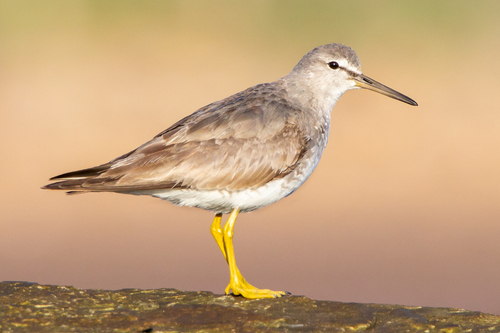
Grey-tailed Tattler
Tringa brevipes
A master of the intertidal zone, the Grey-tailed Tattler is a sleek, silver-grey traveler that journeys from Siberian mountains to tropical shores. Its rhythmic tail-bobbing and sharp, whistling calls make it a charismatic favorite for coastal observers.
Quick Identification
Size
24-27 cm (9.4-10.6 in) long; wingspan 50-55 cm (20-22 in); weight 80-120 g (2.8-4.2 oz)
Colors
Uniform grey upperparts and wings; white underparts with fine grey barring on the breast and flanks during breeding; non-breeding birds are plain grey-white; distinctive yellowish-orange legs.
Key Features
- Short, yellowish legs
- Straight dark bill with a pale base on the lower mandible
- Uniformly grey upperparts without a white rump in flight
- Distinctive rhythmic tail-bobbing motion
When You’ll See Them
Geographic range
Where Does the Grey-tailed Tattler Live?
This resilient traveler is native to the vast wilderness of Northern Asia, specifically breeding in the stony mountain riverbeds of eastern Siberia and the Kamchatka Peninsula. As a dedicated migrant, it spends its non-breeding season across the East Asian-Australasian Flyway, covering a massive range that includes the coasts of Australia, Southeast Asia, Japan, and the Pacific Islands. It is a common sight along the northern and eastern shorelines of Australia and throughout the Indonesian archipelago during the southern summer.
Basemap © OpenStreetMap contributors
Behavior
The Grey-tailed Tattler is an energetic and charismatic shorebird known for its constant "teetering" motion—a rhythmic bobbing of the tail and rear body as it walks. Unlike many other sandpipers that forage in massive, tight-knit flocks, tattlers tend to be more solitary or move in loose, small groups. They are edge specialists, preferring to hunt right where the water meets the land, often running quickly across mudflats or hopping between slippery rocks.
These birds are famous for their vocal nature, earning the name "tattler" because they are often the first to give a loud, whistling alarm call when a predator (or a human) approaches. They are highly migratory, spending their summers in the remote mountains of the northern hemisphere before traveling thousands of miles south to coastal regions for the winter.
EverydayEarth exclusive
Camera Tips
To capture the Grey-tailed Tattler on camera, position your device at a very low angle, ideally just a few inches above the ground, overlooking a rocky shoreline or a patch of intertidal mud. These birds are "edge specialists," so aim your lens at the waterline where the tide is receding. A waterproof housing or a very secure weather-sealed mount is essential, as the best shots often come from areas that may be subject to sea spray or rising tides.
Because Grey-tailed Tattlers are highly sensitive to movement and often flush if they see a human within 30-50 meters, a stationary AI-powered camera is the perfect tool for observing their natural behavior. Set your camera to a fast shutter speed or a high-frame-rate video mode (60fps or higher) to capture their rapid tail-bobbing and quick, darting strikes at prey. They are most active during a "falling tide" when new feeding grounds are being exposed, so timing your camera's active window to the local tide chart is a pro tip.
While you should never use food bait in sensitive coastal ecosystems, you can increase your capture rate by scouting for "high tide roosts." These are elevated spots like flat rocks, fallen logs, or low mangrove branches where the birds gather to rest when the water is too deep to forage. Placing a camera near these resting spots during the two hours surrounding high tide will yield the most detailed, stationary portraits of the bird.
Similar Species
Species that look similar or are commonly confused with Grey-tailed Tattler.
Frequently Asked Questions
Record Grey-tailed Tattler at your habitat
Connect a camera to start building your own species record — AI identifies every visitor automatically.