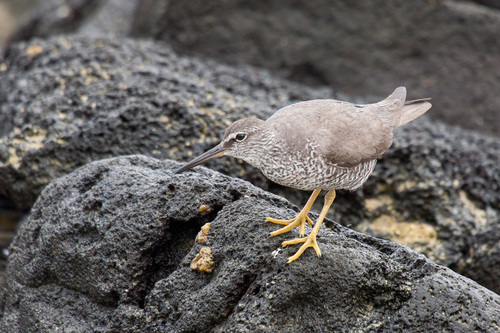
Wandering Tattler
Tringa incana
A hardy specialist of the rocky surf, the Wandering Tattler is a master of the Pacific's most rugged coastlines. With its signature tail-bob and slate-gray camouflage, this solitary traveler is a prize for any coastal wildlife watcher.
Quick Identification
Size
Length: 10-12 in (26-30 cm); Wingspan: 22-27 in (55-70 cm); Weight: 3.2-5.3 oz (90-150 g)
Colors
Uniform slate-gray upperparts and wings. In breeding plumage, the breast and belly feature heavy dark-gray horizontal barring. In winter, the underparts are plain white. Legs are a distinctive dull yellow to olive-green.
Key Features
- Uniform slate-gray wings and back without patterns
- Constant rhythmic tail-bobbing and body-teetering
- Prominent white eyebrow line (supercilium)
- Bright yellow-olive legs
- Straight, dark bill roughly twice the head length
When You’ll See Them
Geographic range
Where Does the Wandering Tattler Live?
The Wandering Tattler is a true Pacific globetrotter, breeding in the remote, mountainous tundra of Alaska, the Yukon, and eastern Siberia. When the northern summer fades, it migrates vast distances to spend the winter along the rocky Pacific coasts of North America, from British Columbia down to the tip of South America. It is also a frequent visitor to the isolated islands of the South Pacific, including Hawaii, and can be found as far west as the rocky shores of eastern Australia and New Zealand.
Basemap © OpenStreetMap contributors
Behavior
The Wandering Tattler is a bird of restless energy and solitary habits. Unlike many other shorebirds that gather in large, swirling flocks, the Tattler is most often found alone, picking its way across slippery, seaweed-drenched rocks just inches from the crashing surf. It earned its name from its distinctive alarm call—a series of rapid, piping notes—that effectively "tattles" on anyone approaching the shoreline, alerting other wildlife to the intrusion.
A defining trait of this species is its constant motion. As it walks, it bobs its tail and teeters its body up and down, a behavior that may help it keep its balance on slick surfaces or perhaps provide better depth perception against the moving ocean. They are incredibly hardy, often foraging in the high-energy "splash zone" where other birds wouldn't dare to stand. While they are focused and wary, they can sometimes be approached if you move slowly, as they rely heavily on their slate-gray camouflage to blend into the rocks.
EverydayEarth exclusive
Camera Tips
Capturing the Wandering Tattler on camera requires focusing on their preferred "splash zone" environment. Because these birds love rocky outcroppings and man-made jetties, place your camera on a stable, low-profile mount or a weighted sandbag about 12 inches off the ground. Aim your lens toward flat, seaweed-covered rocks that are exposed during mid-tide, as these are primary foraging spots. Since the Tattler is slate-gray, setting your camera at a slightly downward angle against a lighter background like wet sand or breaking surf can help the bird pop in the frame.
Timing is everything with this species. The best shots are often captured during a rising tide when the water level pushes the birds higher up the rocks and closer to your camera's location. They have a habit of returning to the same "favorite" rock to scan for predators, so look for stones with visible white guano splashes as prime placement spots. Because their tail-bobbing is constant, use a fast shutter speed (at least 1/1000s) or high-definition video at 60fps to ensure the movement doesn't result in a blurry image.
In terms of lighting, the Wandering Tattler's gray plumage can be difficult to expose correctly against dark rocks or bright white sea foam. If your AI camera allows for exposure compensation, try setting it to +0.3 or +0.7 to preserve the detail in the gray feathers. Always use a waterproof or high-IP-rated housing, as the salt spray from the ocean is corrosive. Wipe the lens with a fresh microfiber cloth daily to remove salt crusting, which can soften the image and reduce clarity.
Similar Species
Species that look similar or are commonly confused with Wandering Tattler.
Frequently Asked Questions
Record Wandering Tattler at your habitat
Connect a camera to start building your own species record — AI identifies every visitor automatically.