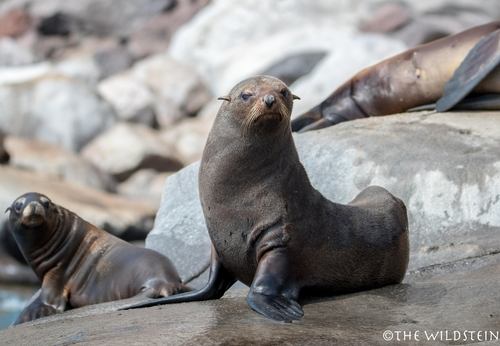
Guadalupe Fur Seal
Arctocephalus townsendi
Once on the brink of extinction, the Guadalupe fur seal is a resilient survivor of the Pacific. With its luxurious fur and dog-like face, this elusive marine mammal is slowly reclaiming its ancient island territories.
Quick Identification
Size
Males reach 2m (6.6 ft) and 160-170kg (350-375 lbs); females reach 1.4m (4.6 ft) and 45-50kg (100-110 lbs)
Colors
Dark brown to blackish-grey coat with a lighter brown belly; adult males develop a silvery-grey 'frosting' on the mane and neck
Key Features
- Long, pointed dog-like muzzle
- Visible external ear flaps
- Thick, double-layered fur
- Rear flippers that can rotate forward for walking on land
- Prominent forehead (sagittal crest) in adult males
When You’ll See Them
Geographic range
Where Does the Guadalupe Fur Seal Live?
Native to the Eastern Pacific Ocean, the Guadalupe fur seal's primary breeding grounds are located on Guadalupe Island and the San Benito Islands off the coast of Baja California, Mexico. While their core population remains centered in Mexican waters, their foraging range has expanded significantly northward during the last decade. Individuals are now frequently spotted along the California coast, particularly around the Channel Islands, and rare sightings have occurred as far north as Washington and British Columbia.
Basemap © OpenStreetMap contributors
Behavior
Guadalupe fur seals are far more solitary and elusive than their more famous cousins, the California sea lions. When not breeding, these seals spend much of their lives in the open ocean, often traveling hundreds of miles alone to reach deep-sea foraging grounds. They are exceptional divers, specialized for deep-water hunting at night when their prey migrates toward the surface.
On land, they are known for their shy and cautious temperament. Unlike other seals that lounge in the open sun, the Guadalupe fur seal often seeks out the shade of rocky overhangs, crevices, or sea caves. During the breeding season (June-August), dominant males become highly territorial, defending rocky stretches of coastline where females gather to pup and mate.
EverydayEarth exclusive
Camera Tips
Capturing a Guadalupe fur seal on camera requires a specialized approach due to their preference for rugged, inaccessible terrain. If you have coastal access, focus your camera placement on rocky 'haul-out' spots rather than sandy beaches. These seals specifically look for jagged volcanic rocks or boulders that provide crevices for shelter. Position your camera at a low angle, roughly 1-2 feet off the ground, to capture their distinct profile and pointed muzzle as they move between the water and their resting spots.
Because salt spray and heavy moisture are guaranteed in their habitat, use a high-quality weather-sealed housing or a secondary waterproof enclosure. Salt buildup on the lens will ruin images, so treat the lens cover with a hydrophobic coating (like Rain-X) and plan to clean it weekly with fresh water and a microfiber cloth. To capture their nocturnal foraging behavior, ensure your camera has a strong 'No-Glow' infrared flash; these seals are easily spooked by visible light and may abandon a haul-out spot if disturbed by bright white flashes.
Time-lapse mode can be more effective than PIR (motion) triggers in coastal environments, as the constant movement of waves and kelp often causes false triggers. Set your camera to take a photo every 5-10 minutes during the daylight hours when they are most likely to be basking. During the summer breeding season, look for high-traffic 'chutes'—smooth paths between rocks where seals slide into the water—as these are the most reliable spots for high-quality activity shots.
Similar Species
Species that look similar or are commonly confused with Guadalupe Fur Seal.
California Sea Lion
Sea lions have a much blunter snout, lack the thick underfur of the fur seal, and are generally more social and loud.
Northern Fur Seal
Northern fur seals have a much shorter, almost 'pug-like' snout and significantly larger rear flippers.
Harbor Seal
Harbor seals lack external ear flaps and cannot rotate their rear flippers forward to walk; they 'galumph' on their bellies instead.
Frequently Asked Questions
Record Guadalupe Fur Seal at your habitat
Connect a camera to start building your own species record — AI identifies every visitor automatically.