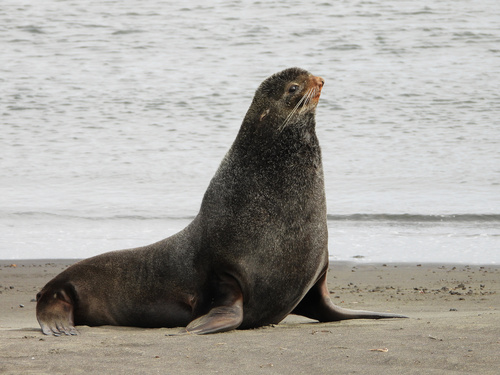
Northern Fur Seal
Callorhinus ursinus
The Northern Fur Seal is the charismatic athlete of the North Pacific, known for its incredible migration and thick, luxurious coat. While they spend most of their lives at sea, their seasonal return to land offers a spectacular display of social complexity and raw natural power.
Quick Identification
Size
Males reach 7 feet (2.1 m) and up to 600 lbs (270 kg); females are much smaller at 5 feet (1.5 m) and 110 lbs (50 kg).
Colors
Adult males are dark brown to charcoal gray with a thick mane; females are typically silver-gray on the back and reddish-brown or cream on the chest.
Key Features
- Extremely thick, dense double-layer of fur
- Pointed, short snout with a small nose
- Large, hairless hind flippers that fold forward
- Pronounced thick neck and mane in adult males
When You’ll See Them
Behavior
Northern Fur Seals are highly social yet notoriously territorial animals, especially during the summer breeding season. They spend the vast majority of their lives—roughly 300 days a year—at sea, only coming ashore to rocky beaches and islands to pup and mate. On land, they are more agile than many other seals because they can rotate their hind flippers forward to walk or even gallop across the rocks.
In the water, they are solitary hunters but may congregate in areas with high prey density. While they are capable of deep dives, they often feed at night when their prey migrates closer to the surface. Interactions with humans are rare and strictly regulated, as these seals are sensitive to disturbance and can be quite aggressive if they feel their territory or pups are threatened.
EverydayEarth exclusive
Camera Tips
Capturing the Northern Fur Seal on a trail camera requires a specialized approach, as these animals are rarely found in traditional backyards unless you own coastal property near a known haul-out site. Because they are protected under the Marine Mammal Protection Act, you must place your camera well away from the animals to avoid any harassment. A high-angle mount on a cliffside or a sturdy tripod weighted down with sandbags on a rocky overlook is ideal. Aim for a wide-angle view of the shoreline to capture the scale of the colony, or use a camera with a high-quality zoom lens to get close-up shots of social interactions without physically approaching the beach.
Due to the harsh coastal environment, your camera needs protection from salt spray and high humidity. Use a dedicated weather housing and consider applying a water-repellent coating to the lens cover to prevent salt crusting or fogging. Since beaches are high-contrast environments with bright sand and dark rocks, look for a camera with high dynamic range (HDR) capabilities. This ensures the dark fur of the males isn't 'crushed' into a black silhouette while the sun reflects off the water in the background.
Timing is everything with this species. Set your camera to 'Time Lapse' mode during the peak of the breeding season in June and July. This allows you to witness the fascinating territorial shifts of the bulls and the arrival of the pups without filling your SD card with thousands of motion-triggered clips of moving waves. If you are using motion triggers, set the sensitivity to high, as the rolling motion of seals on rocks can sometimes be more subtle than the gait of a land mammal. For the best lighting, configure your camera to be most active during the 'golden hours' of dawn and dusk when the sun isn't directly overhead.
Similar Species
Species that look similar or are commonly confused with Northern Fur Seal.
California Sea Lion
Sea lions have a longer, more sloping forehead and shorter hind flippers without the Fur Seal's extremely thick undercoat.
Steller Sea Lion
Significantly larger and more blonde/tan in color, with a much blunter snout and lacking the dense fur of the Northern Fur Seal.
Guadalupe Fur Seal
The Guadalupe Fur Seal has a more elongated, 'collie-like' snout compared to the blunt, short snout of the Northern Fur Seal.
Frequently Asked Questions
Record Northern Fur Seal at your habitat
Connect a camera to start building your own species record — AI identifies every visitor automatically.