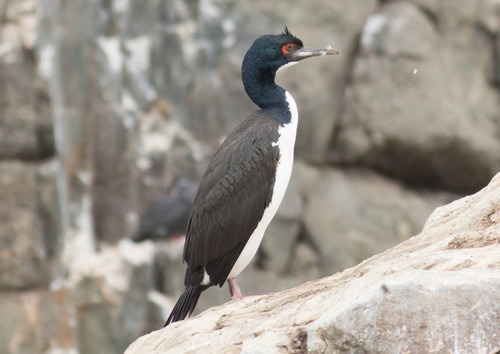
Guanay Cormorant
Leucocarbo bougainvilliorum
The Guanay Cormorant is the undisputed 'King of Guano,' a sleek, tuxedoed diver that thrives in the crashing waves of the South American Pacific. Witness the power of the Humboldt Current through the eyes of this magnificent, colonial seabird.
Quick Identification
Size
Length 71-76 cm (28-30 inches); wingspan approximately 100 cm (39 inches); weight 1.8-2.5 kg (4-5.5 lbs)
Colors
Glossy black upperparts (head, neck, back, wings) contrasting with stark white breast and belly; pinkish-flesh legs and feet; distinctive red skin patch around the eyes and a blue-green orbital ring
Key Features
- Stark white underparts extending up the front of the neck
- Vibrant red skin patch (lores) between the eye and bill
- Pinkish-red feet and legs
- Stocky build with a thick, hooked bill
When You’ll See Them
Geographic range
Where Does the Guanay Cormorant Live?
Native to the western coast of South America, the Guanay Cormorant is a quintessential resident of the cold, nutrient-rich Humboldt Current. Its core population is concentrated along the rocky shores and offshore islands of Peru and northern Chile, where it finds abundant food supplies. While they are primarily non-migratory, significant food shortages during El Niño years can trigger mass dispersals, leading sightings as far north as Ecuador, Colombia, and even Panama.
Basemap © OpenStreetMap contributors
Behavior
The Guanay Cormorant is one of the most social and gregarious seabirds in the world, often congregating in colonies that can number in the hundreds of thousands. They are famous for their role in the guano industry, as their concentrated droppings on rocky islands have historically been harvested as high-quality fertilizer. At sea, they travel in massive 'rafts,' often following schooling fish in spectacular, coordinated movements that can be seen from miles away.
These birds are pursuit-divers, meaning they propel themselves underwater using their powerful webbed feet to chase down prey. Unlike many other cormorants that sit low in the water, the Guanay is often seen standing upright on rocky outcroppings, spreading its wings to dry after a hunt. While generally wary of humans, they have become a symbol of the Peruvian coast and are a focal point for ecological conservation efforts due to their sensitivity to shifting ocean temperatures.
EverydayEarth exclusive
Camera Tips
Capturing the Guanay Cormorant on camera requires a strategy focused on coastal geography. Since these birds are strictly marine, your camera should be positioned on a cliff edge, pier, or a private shoreline with a clear view of rocky outcroppings. Because they are highly social, aim for a wide-angle lens if you are near a nesting site to capture the sheer scale of the colony, or use a telephoto-equipped AI camera if you are monitoring a specific drying perch from a distance.
Height and angle are critical. Position your camera at or slightly above eye level relative to the rocks where they sun themselves. This avoids the 'flat' look of shooting from below and captures the striking contrast between their black backs and white bellies. Use a high-speed trigger setting or a short 'cool-down' period; when these birds arrive or depart, they do so in quick succession, and you don’t want to miss the landing sequence which often involves dramatic wing-flapping.
Because the Guanay Cormorant inhabits salt-spray environments, weatherproofing is your biggest hurdle. Use a dedicated marine-grade housing or a protective silicone skin for your camera to prevent corrosion. Lighting is best in the early morning or late afternoon when the sun isn't directly overhead, as the harsh midday sun on the Peruvian coast can easily blow out the white feathers on their breast, losing all detail in your shots.
Finally, avoid using traditional bait, as these birds only respond to live fish in the water. Instead, focus your camera on 'drying rocks'—favored spots where birds regularly retreat after fishing. If your camera supports scheduling, ensure it is active during the golden hours, as the red facial skin of the Guanay glows beautifully in the low-angled sun.
Similar Species
Species that look similar or are commonly confused with Guanay Cormorant.
Frequently Asked Questions
Record Guanay Cormorant at your habitat
Connect a camera to start building your own species record — AI identifies every visitor automatically.