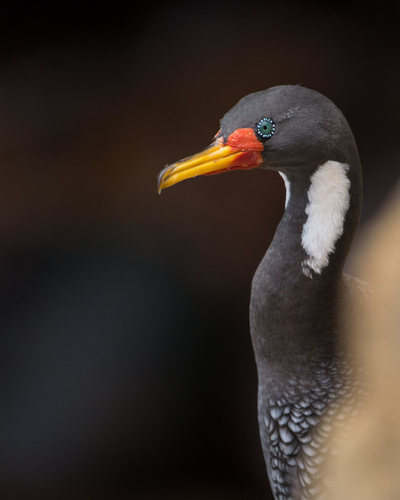
Red-legged Cormorant
Poikilocarbo gaimardi
Meet the rebel of the cormorant family: a solitary cliff-dweller with striking turquoise eyes and neon-red feet. The Red-legged Cormorant trades the crowded colony for the rugged beauty of South America's rocky coastlines.
Quick Identification
Size
Length: 71–76 cm (28–30 in); Wingspan: 90–100 cm (35–39 in); Weight: 1.2–1.5 kg (2.6–3.3 lbs)
Colors
Distinctive smoky grey plumage with subtle white speckling on the neck. Bright neon-red to orange-red legs and feet. Yellow-orange bill with a prominent red base and striking turquoise eyes.
Key Features
- Vibrant red or orange-red legs and feet
- Uniform smoky-grey plumage with a white neck patch
- Yellowish bill with a bright red base
- Solitary or paired behavior, rarely in large colonies
When You’ll See Them
Behavior
The Red-legged Cormorant is a fascinating outlier among seabirds. While most cormorants are highly social and nest in dense, noisy colonies, this species is decidedly non-colonial. You are more likely to spot them as solitary figures or in quiet pairs perched precariously on the steep, rugged cliffs of the South American coastline. They are masters of the 'splash zone,' navigating the turbulent waters where the Pacific and Atlantic waves crash against rocky outcrops.
Interestingly, this species lacks the iconic 'wing-spreading' posture common to almost all other cormorants. While their cousins stand for hours with wings outstretched to dry their feathers, the Red-legged Cormorant keeps its wings tucked, suggesting a different feather structure or a more efficient waterproofing method. They are generally shy around humans, preferring inaccessible cliff faces where they build nests out of seaweed and guano.
EverydayEarth exclusive
Camera Tips
To capture high-quality footage of a Red-legged Cormorant, your best bet is to focus on 'sentinel' rocks. These birds are creatures of habit and will return to the same rocky perch day after day to rest between fishing trips. Look for rocks near the shoreline that are heavily marked with white guano; these are prime locations for camera placement. Use a tripod and position your camera at a slight downward angle to capture the bird against the backdrop of the ocean, which highlights their unique grey coloration and red legs.
Because these birds inhabit high-contrast environments—bright white surf against dark volcanic rocks—exposure management is critical. If your camera has manual settings, underexpose by 0.5 or 1.0 stop to prevent the white patch on their neck from 'blowing out' in the midday sun. Fast shutter speeds (at least 1/1000s) are essential if you want to freeze the action as they emerge from the water or navigate the spray. Since they are diurnal, ensure your camera is set to record during daylight hours to save battery and storage space.
Standard lures and baits are ineffective for this species, as they only hunt live, moving prey in the water. Instead, use 'visual baiting' by identifying their preferred nesting ledges or resting spots. If you are using a trail camera, set it to a short trigger interval with a 3-5 shot burst. These birds often perform subtle head-bobbing or preening movements that are better captured in a sequence rather than a single still image. Avoid placing cameras too close to active nests to prevent disturbing their breeding cycle; a telephoto lens or a camera with a decent zoom is preferred.
Similar Species
Species that look similar or are commonly confused with Red-legged Cormorant.
Frequently Asked Questions
Record Red-legged Cormorant at your habitat
Connect a camera to start building your own species record — AI identifies every visitor automatically.