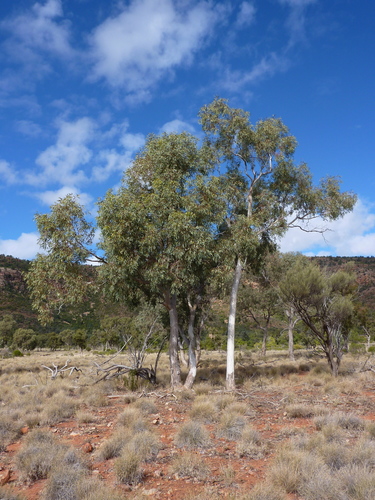
Gum-barked Coolibah
Eucalyptus intertexta
A resilient icon of the Australian outback, the Gum-barked Coolibah is a two-toned beauty that provides a lifeline for desert wildlife. From its rough, protective 'stocking' of bark to its nectar-rich white blossoms, this tree is a bustling hub for birds, reptiles, and insects alike.
Quick Identification
Size
Medium-sized tree reaching 15–25 metres (50–80 feet) in height with a canopy spread of 10–15 metres (33–50 feet).
Colors
Rough, grey-brown flaky bark on the lower trunk with smooth, white to creamy-yellow bark on upper branches; dull blue-green to grey-green lance-shaped leaves.
Key Features
- Two-toned bark: rough and box-like at the base, smooth and white above
- Dull, lance-shaped leaves measuring 7–14 cm long
- Small, white flowers in clusters of seven at the branch tips
- Cup-shaped or hemispherical woody fruit (gumnuts) 4–8 mm wide
When You’ll See Them
Geographic range
Where Does the Gum-barked Coolibah Live?
Native to the vast heart of the Australian continent, the Gum-barked Coolibah is a quintessential feature of the inland landscape. Its distribution spans nearly all mainland states, stretching from the eastern goldfields of Western Australia through the southern Northern Territory and across the arid plains of South Australia, Queensland, and New South Wales. It is most commonly encountered in the transition zones between the high-rainfall coast and the true desert, thriving where few other large trees can survive.
Basemap © OpenStreetMap contributors
Behavior
The Gum-barked Coolibah is a resilient and long-lived evergreen tree that serves as a cornerstone of the Australian interior ecosystem. Unlike many eucalyptus species that drop their lower bark entirely, the Coolibah retains a distinctive 'stocking' of rough, fibrous bark at the base of its trunk, which provides a micro-habitat for diverse insect populations and small reptiles. It grows at a moderate rate, developing a wide-spreading canopy that offers vital shade in the heat of the semi-arid outback.
Ecologically, this species is famous for its 'intertexta' name, referring to the interweaving of its wood grain, which makes the timber exceptionally tough and resistant to rot. While it doesn't move like an animal, it 'behaves' by opportunistically flowering after significant rainfall, providing a sudden burst of nectar for nomadic nectar-feeding birds and insects. In suburban or pastoral settings, it is often left as a shade tree due to its ability to survive long periods of drought without losing its structural integrity.
EverydayEarth exclusive
Camera Tips
When using an AI-powered camera to monitor a Gum-barked Coolibah, focus your lens on the transition zone between the rough bark at the base and the smooth bark higher up. This area is a high-traffic highway for arboreal lizards like Geckos and Skinks, as well as predatory spiders. Mount your camera about 1.5 to 2 metres up the trunk, angled slightly downward to capture both the texture of the bark and any movement along the main stem.
The canopy of the Coolibah is a magnet for birdlife. If your camera is high-reach or pole-mounted, aim it toward the outer branchlets during the flowering season (typically May to October). The white blossoms attract honeyeaters, lorikeets, and bees in large numbers. Because the leaves are dull and don't reflect much light, you can use a higher exposure setting on your camera to capture the fine details of visiting birds without worrying about 'white-out' from leaf glare.
For those interested in nocturnal wildlife, the Gum-barked Coolibah is a prime spot for nesting hollows. Use an infrared-capable camera directed at visible holes or hollow spouts in the older branches. You are likely to capture Brush-tailed Possums or owls as they emerge at dusk. Ensure your trigger speed is set to the fastest possible setting, as many Australian parrots move quickly through the canopy.
Similar Species
Species that look similar or are commonly confused with Gum-barked Coolibah.
Frequently Asked Questions
Record Gum-barked Coolibah at your habitat
Connect a camera to start building your own species record — AI identifies every visitor automatically.