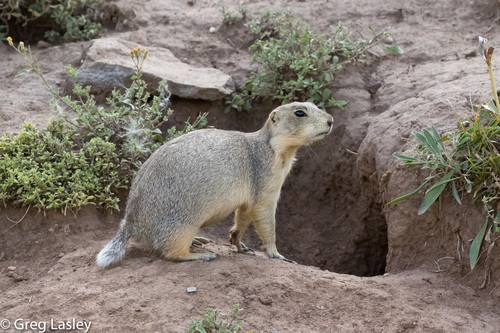
Gunnison's Prairie Dog
Cynomys gunnisoni
Meet the most sophisticated linguist of the American Southwest. The Gunnison's Prairie Dog is a social architect of the high-altitude plains, known for its complex communication and iconic burrowing lifestyle.
Quick Identification
Size
Length 30–37 cm (12–15 inches); Weight 650–1,200 g (1.4–2.6 lbs)
Colors
Yellowish-buff coat grizzled with black/brown; pale white-to-buff underbelly; tail has a distinct grayish-white tip
Key Features
- Grayish-white tipped tail
- Yellow-cinnamon fur with dark-tipped hairs
- Stocky, squirrel-like body
- High-pitched complex alarm calls
When You’ll See Them
Geographic range
Where Does the Gunnison's Prairie Dog Live?
Native to the high plateaus and mountain valleys of the North American Southwest. Their core range is strictly limited to the Four Corners region, spanning across parts of Arizona, New Mexico, Colorado, and Utah. While they are not an introduced species elsewhere, their distribution within this regional pocket is patchy, often dictated by the availability of suitable soil for deep burrowing.
Basemap © OpenStreetMap contributors
Behavior
Gunnison's Prairie Dogs are highly social rodents that live in "towns" or colonies, though their social structures are slightly less rigid than their black-tailed cousins. They are famously vocal, possessing one of the most sophisticated languages in the animal kingdom; their alarm calls can describe specific predators, including their size, color, and speed. Most of their day is spent foraging or performing sentry duty on dirt mounds.
Unlike some prairie dog species, Gunnison's are true hibernators. They retreat to their deep burrow systems in late autumn and don't emerge until the snow begins to melt in early spring. While they generally avoid humans, they can become accustomed to presence in park settings, though they remain wary and will dive into burrows at the first sign of a threat.
EverydayEarth exclusive
Camera Tips
To capture the best footage of Gunnison's Prairie Dogs, position your camera 12 to 18 inches off the ground. Aim it toward a fresh mound with active "tailings" (loose dirt), as this indicates a main entrance currently in use. A wide-angle lens is ideal because these rodents are social and you’ll likely capture multiple individuals interacting or performing their signature "jump-yip" display.
Lighting is your best friend with this species. Because they are strictly diurnal, early morning or late afternoon sun provides a warm glow on their buff-colored fur and reduces the harsh shadows found in open grasslands at noon. Avoid placing the camera directly in the path of the burrow entrance to prevent it from being buried in dirt as they excavate, and ensure the PIR sensor is sensitive enough to trigger on small movements.
While baiting isn't usually necessary if you find an active town, a handful of native sunflower seeds or fresh greens placed near a sentinel mound can encourage them to linger in the frame. Be mindful of the season; if you're setting up between October and March, you likely won't see any activity at all due to their deep hibernation cycle. High-speed video settings are recommended to catch the rapid flicking of their tails and their lightning-fast retreats into the earth.
Similar Species
Species that look similar or are commonly confused with Gunnison's Prairie Dog.
Frequently Asked Questions
Record Gunnison's Prairie Dog at your habitat
Connect a camera to start building your own species record — AI identifies every visitor automatically.