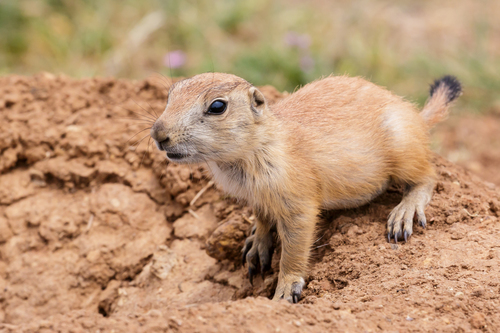
Black-tailed Prairie Dog
Cynomys ludovicianus
The charismatic socialites of the American Great Plains, black-tailed prairie dogs are famous for their complex 'towns' and expressive vocalizations.
Quick Identification
Size
14 to 17 inches (36–43 cm) in length; weight ranges from 1.5 to 3 lbs (0.7–1.4 kg)
Colors
Tan to cinnamon-brown upper body with a creamy white or buff underbelly and a distinctive black-tipped tail.
Key Features
- Distinctive black tip on the tail
- Short, rounded ears that barely protrude from the fur
- Stocky, low-profile body with short legs
- Sharp, dark claws specialized for digging
- Highly social 'jump-yip' display behavior
When You’ll See Them
Geographic range
Where Does the Black-tailed Prairie Dog Live?
The black-tailed prairie dog is native to the Great Plains of North America, occupying a vast interior corridor of the continent. Their range begins in the southern reaches of Saskatchewan, Canada, and extends southward through the central United States—covering states from Montana and the Dakotas down to Texas and New Mexico—before reaching its southern limit in Northern Mexico. While their contemporary range is much more fragmented than it was historically, they remain a quintessential species of the American West.
Basemap © OpenStreetMap contributors
Behavior
The black-tailed prairie dog is a master of social organization, living in complex underground 'towns' that can span hundreds of acres. These towns are divided into family groups called coteries, typically consisting of one adult male, several females, and their offspring. Within these groups, you'll often see them engaged in social grooming or performing the famous 'jump-yip' display—a rhythmic bark and stretch used to communicate safety or territorial boundaries to neighbors.
Unlike many other prairie dog species, the black-tailed variety does not truly hibernate. While they may stay underground for several days during a severe winter storm, they remain active throughout the year and can be seen foraging on the surface even in midwinter. They are strictly diurnal, spending their daylight hours foraging, maintaining burrow mounds, and acting as sentinels, standing tall on their hind legs to scan the horizon for predators like hawks, ferrets, and coyotes.
EverydayEarth exclusive
Camera Tips
Capturing high-quality footage of black-tailed prairie dogs requires getting low to the ground. Because these animals are only about a foot tall, mounting your camera on a short stake or tripod just 6 to 10 inches above the earth provides a much more intimate and engaging perspective than a high-angle shot. Position the camera near a 'sentinel mound'—the raised dirt entrance to a burrow—as this is where they spend significant time standing upright to scan for danger. Aim the camera to face north or south to avoid the harsh glare of the rising or setting sun, which can wash out the details of their tan fur.
Since prairie dogs are highly social, setting your camera to 'Burst Mode' or high-frame-rate video is essential. Their interactions, like the 'greeting kiss' or the 'jump-yip' bark, happen very quickly. A single photo often misses the peak of the action, while a burst of 3-5 images or a 20-second video clip will capture the full range of their expressive communication. If you are placing a camera in a backyard or pasture, look for areas where the grass is clipped short, as these are active foraging zones where they feel safest.
Patience and weather-proofing are key. While they are active year-round, you'll get the most vibrant footage in late spring when the pups (yearlings) first emerge from the burrows to play. Ensure your camera housing is secure and perhaps even camouflaged with local grasses; prairie dogs are notoriously curious and may attempt to nibble on or dig under your equipment. Avoid using heavy lures or food baits that aren't part of their natural diet, as they are cautious of new scents; instead, rely on placement near active trail runs between burrow entrances.
Similar Species
Species that look similar or are commonly confused with Black-tailed Prairie Dog.
White-tailed Prairie Dog
Has a white-tipped tail and hibernates during the winter months, unlike the black-tailed variety.
Gunnison's Prairie Dog
Smaller with a gray-tipped tail and prefers higher elevations in the Four Corners region.
Richardson's Ground Squirrel
Often called 'flickertails,' they are smaller, less social, and lack the distinct black tail tip.
Frequently Asked Questions
Record Black-tailed Prairie Dog at your habitat
Connect a camera to start building your own species record — AI identifies every visitor automatically.