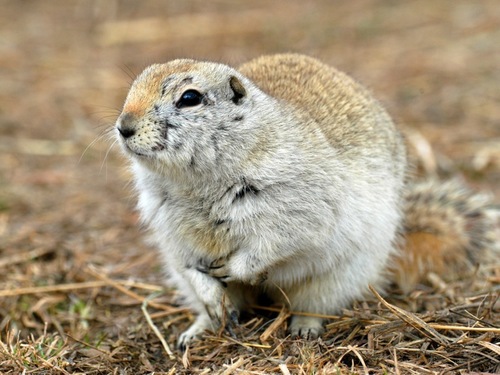
Richardson's Ground Squirrel
Urocitellus richardsonii
The 'flickertail' of the prairies, Richardson's Ground Squirrel is a master of the upright alert. Watch as these social sentinels whistle, forage, and build complex underground cities right in your backyard.
Quick Identification
Size
Total length 28-35 cm (11-14 in); Weight 200-600g (0.4-1.3 lbs) depending on season.
Colors
Uniformly tawny or smoky-gray upper body; buff or pale white underside; tail often has a darker edge with white frosting.
Key Features
- Picket-pin stance standing bolt upright on hind legs
- Short tail with a characteristic flicking motion
- Uniformly colored coat without stripes or spots
- Small ears that lie flat against the head
When You’ll See Them
Behavior
Richardson's Ground Squirrels are highly social and industrious rodents famous for their 'picket pin' posture. This upright stance allows them to scan the flat prairie landscape for predators like hawks, badgers, and coyotes. When a threat is detected, they emit a piercing, high-pitched whistle that alerts the entire colony to retreat into their complex network of underground burrows.
These animals are extreme hibernators, spending the vast majority of their lives underground. Adults may emerge as early as March to breed but often return to hibernation by July or August once they have cached enough fat. This brief window of surface activity makes them a fascinating, if fleeting, addition to any backyard observation project.
EverydayEarth exclusive
Camera Tips
To capture the best footage of Richardson's Ground Squirrels, camera placement is everything. You want to set your AI camera at ground level, no more than 6 to 10 inches off the dirt. Look for 'sentinel mounds'—the small piles of excavated dirt near burrow entrances. These are prime spots where the squirrels will stop and stand upright to scan the area, providing that iconic 'picket pin' photo op.
Because these squirrels are incredibly fast and twitchy, set your camera to its fastest trigger speed. If your device allows for 'Burst Mode' or 'Photo + Video,' enable it. The squirrels often flick their tails or whistle before diving into a hole, and a multi-shot burst is the only way to catch those split-second behaviors. A wide-angle lens is preferred if you are placing the camera close to a burrow entrance.
Timing is critical for this species due to their long hibernation cycle. In the Northern Great Plains, the best window for activity is between late March and early July. To keep them in the frame longer, you can place a small handful of black oil sunflower seeds or a slice of apple on a flat rock in front of the camera. This encourages them to pause and forage rather than just scurrying past.
Finally, consider the lighting. Since they are strictly diurnal and love the sun, try to position your camera facing North or South. This prevents the harsh midday sun from washing out the tawny details of their fur and avoids lens flare, ensuring the AI can easily identify the species based on its uniform coloration and silhouette.
Similar Species
Species that look similar or are commonly confused with Richardson's Ground Squirrel.
Frequently Asked Questions
Record Richardson's Ground Squirrel at your habitat
Connect a camera to start building your own species record — AI identifies every visitor automatically.