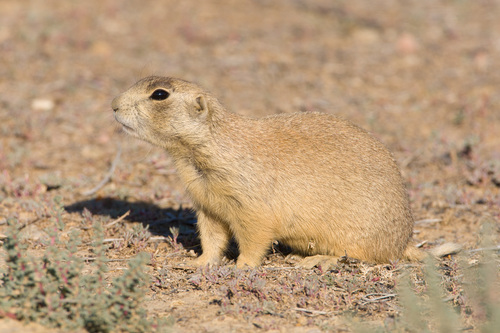
White-tailed Prairie Dog
Cynomys leucurus
The hardy 'chiseler' of the high country, the White-tailed Prairie Dog is a master of communication and high-altitude survival. Look for their distinctive white-tipped tails and 'masked' faces across the mountain basins of the West.
Quick Identification
Size
Length: 13-15 inches (33-38 cm); Weight: 1.5-2.5 lbs (0.7-1.1 kg). Males are generally about 10% larger than females.
Colors
Pale brownish-tan or tawny coat with a distinct white-tipped tail. Features dark brown to blackish patches above and below the eyes, resembling a small mask.
Key Features
- Distinctive white-tipped tail
- Dark brown 'eyebrow' patches
- Stocky, squirrel-like body with short legs
- Small, rounded ears pinned close to the head
When You’ll See Them
Behavior
White-tailed Prairie Dogs are the rugged high-altitude residents of the prairie dog world. Unlike their cousins on the Great Plains, they live in smaller, more loosely organized family groups. They are famous for their complex communication systems, using high-pitched 'barks' to alert the colony to specific threats, with different calls to distinguish between an eagle in the sky and a badger on the ground.
These rodents are significant ecosystem engineers. Their burrowing aerates the soil and creates vital habitats for other species, including the endangered black-footed ferret. While they are less social than the Black-tailed variety, they still maintain a sophisticated social structure within their smaller 'towns,' often engaging in tactile behaviors like grooming and 'greeting kisses' to identify clan members.
EverydayEarth exclusive
Camera Tips
To capture the best footage of White-tailed Prairie Dogs, focus your camera placement on the periphery of active burrow mounds. These animals are naturally wary of anything new in their environment, so use a low-profile stake to mount your camera only 12-18 inches off the ground. Angle the lens slightly upward toward the highest point of a mound, which they frequently use as a lookout post to scan for predators.
Because they live at high elevations where the sun can be incredibly intense, positioning is critical to avoid 'blown out' images. Aim your camera North or South to prevent the sun from shining directly into the lens during their peak activity hours in the morning and late afternoon. Set your camera's trigger speed to the fastest setting possible; these 'chiselers' are lightning-fast and can dive back into their tunnels in a heartbeat if they sense movement.
While baiting is generally discouraged near burrows as it can attract dangerous predators like badgers or coyotes, you can encourage them to pause in front of your camera by placing a flat, sun-warmed rock in the frame. Prairie dogs love to sun themselves on these rocks during the cooler morning hours. This provides a perfect 'stage' for capturing social interactions, grooming, or their iconic upright 'sentry' pose.
Seasonality is the most important factor for this species. Unlike Black-tailed Prairie Dogs that stay active in winter, the White-tailed species hibernates for 4-6 months. Plan your deployments for late spring (May and June) when the year's pups first emerge from the burrows. The juveniles are much more curious and less camera-shy than the adults, providing excellent opportunities for high-quality, close-up video clips.
Similar Species
Species that look similar or are commonly confused with White-tailed Prairie Dog.
Black-tailed Prairie Dog
Has a distinct black-tipped tail, lives at lower elevations, and does not hibernate in the winter.
Wyoming Ground Squirrel
Much smaller and more slender than a prairie dog, with a thinner tail and no dark patches around the eyes.
Gunnison's Prairie Dog
Also has a white-tipped tail but features a more grayish coat and is typically found further south in the Four Corners region.
Frequently Asked Questions
Record White-tailed Prairie Dog at your habitat
Connect a camera to start building your own species record — AI identifies every visitor automatically.