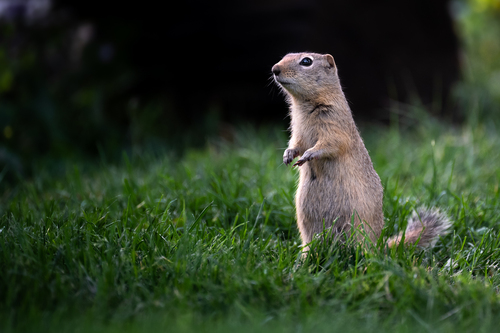
Wyoming Ground Squirrel
Urocitellus elegans
A vigilant sentry of the sagebrush, the Wyoming Ground Squirrel is a master of the high-plains hustle. Known for their upright 'picket pin' stance and lightning-fast retreats, these charismatic burrowers are a joy to observe during their brief summer season.
Quick Identification
Size
10-12 inches (25-30 cm) in length; weighs 6-14 ounces (170-400 g)
Colors
Buffy-gray or brownish-tan upper body with a paler, cream-colored underside; tail is short with a white or buff border
Key Features
- Stocky, cylindrical body with short ears
- Plain, unstriped back distinguishing it from chipmunks
- Short, narrow tail with a light-colored fringe
- Large, dark eyes set high on the head
When You’ll See Them
Behavior
Wyoming Ground Squirrels are quintessential 'sentinels' of the open range. They spend a significant portion of their day standing upright on their hind legs, scanning the horizon for predators like hawks or coyotes. When a threat is detected, they emit a sharp, high-pitched alarm chirp that sends the entire colony scurrying back into their complex underground burrow systems. Despite living in colonies, they are somewhat more solitary in their individual tunnel management than prairie dogs.
These rodents are highly seasonal and spend the majority of their lives underground. They enter a state of dormancy (estivation) as early as July or August to escape the late summer heat and drought, transitioning directly into winter hibernation. This means they are only active above ground for about 4 to 5 months out of the year, during which time they must feed voraciously to build up fat reserves for their long slumber.
EverydayEarth exclusive
Camera Tips
To capture the best footage of a Wyoming Ground Squirrel, location is everything. Look for 'towns' or clusters of burrow entrances, which are usually marked by mounds of excavated dirt in open, sunny areas. Place your camera about 12 to 18 inches off the ground, angled slightly downward toward a well-used burrow entrance or a flat 'sunning rock' nearby. Because these squirrels are low to the ground, a standard fence-post height will likely miss the action or only capture the tops of their heads.
While they are naturally curious, they are also quite skittish. Avoid placing the camera directly over the hole, as the new object may cause them to use a different exit. Instead, set the camera 5-10 feet back and use a small 'lure' of black oil sunflower seeds or a few slices of fresh apple to encourage them to linger in the frame. This 'stop-and-pose' technique is much more effective than trying to catch them as they dart between tunnels.
Technical settings are crucial for these fast-movers. Set your camera to 'Burst Mode' or 'Photo + Video' to ensure you catch the moment they stand up on their hind legs—the classic Wyoming Ground Squirrel pose. Use a high trigger speed (0.5 seconds or less) because they can disappear into a hole in the blink of an eye. Since they are strictly diurnal, you can disable the infrared flash during the day to save battery life, but keep it on if you’re hoping to catch predators like badgers or foxes investigating the burrows at night.
Timing is the final piece of the puzzle. If you set your camera out in September, you likely won't see a thing until the following spring. Plan your deployments for late April or May when the adults emerge and the young 'pups' begin to explore the surface. This is when the colonies are most active and social, providing the most entertaining footage for your collection.
Similar Species
Species that look similar or are commonly confused with Wyoming Ground Squirrel.
Richardson's Ground Squirrel
Found further north; slightly larger and more robust than the Wyoming species.
Thirteen-lined Ground Squirrel
Easily distinguished by the 13 distinct brownish and white stripes and spots running down its back.
Uinta Ground Squirrel
Has a grayer coat and a shorter tail with a grayish (rather than buff) underside.
Frequently Asked Questions
Record Wyoming Ground Squirrel at your habitat
Connect a camera to start building your own species record — AI identifies every visitor automatically.