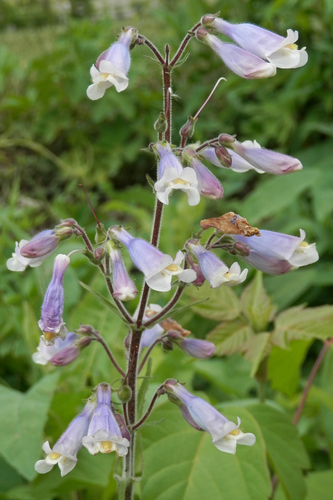
hairy beardtongue
Penstemon hirsutus
A resilient beauty of the Eastern meadows, the hairy beardtongue offers delicate lavender blooms and a unique 'fuzzy' texture that invites native pollinators to your garden.
Quick Identification
Size
12-24 inches (30-60 cm) in height; 8-12 inches (20-30 cm) in spread
Colors
Pale lavender to deep violet tubular flowers with white interior lobes; stems are olive green to burgundy-red
Key Features
- Fine white hairs covering the stems and leaves
- Tubular, two-lipped flowers in terminal clusters
- Semi-evergreen basal foliage that turns reddish in winter
- A prominent sterile stamen (staminode) featuring a tuft of yellow 'beard' hairs
When You’ll See Them
Behavior
Hairy beardtongue is a hardy, clump-forming perennial that acts as a cornerstone for early summer biodiversity. It is a pioneer species of sorts, often colonizing dry, rocky areas where other plants struggle. While it remains stationary, it exhibits a fascinating 'behavioral' relationship with its environment, opening its blooms just as native bee populations peak in late spring.
The plant is specifically evolved for 'entry-fee' pollination. Its tubular flowers are sized perfectly for medium-sized bees, which must push past the hairy sterile stamen to reach the nectar. This ensures that the insect makes firm contact with the pollen-bearing anthers. In a backyard setting, it is a polite neighbor, spreading slowly via seed without becoming invasive like some of its more aggressive cousins.
EverydayEarth exclusive
Camera Tips
To get the best shots of hairy beardtongue, you need to go low. Mount your camera on a ground stake or a mini-tripod at a height of about 12 to 18 inches. Aiming the lens horizontally at the flower clusters will allow you to see directly into the 'throat' of the blooms, which is where all the action happens. If possible, position the camera so it is backlit by the morning sun; this will highlight the 'hirsute' (hairy) nature of the stems, making them glow in your photos and videos.
Because this species is a favorite of the Hummingbird Clearwing Moth and various native bumblebees, set your camera to its fastest trigger speed. These pollinators spend only a second or two at each flower. If you are using an AI-powered camera, ensure the 'motion zone' is centered on the flower spikes rather than the leaves at the base to avoid false triggers from wind-blown foliage.
A time-lapse setting is particularly rewarding for this species. Set your camera to take a photo every 20 minutes over the course of three days in late May. You will capture the dramatic 'unzipping' of the flower spikes as the lavender buds open from the bottom of the stalk toward the top. This provides a professional-grade look at the plant's life cycle that most casual observers never get to see.
Finally, pay attention to the background. Since the flowers are a soft lavender, they can sometimes get lost against a busy green backdrop. Try to position your camera so there is a dark shadow or a neutral-colored rock behind the plant. This contrast will make the delicate purple hues and the white 'lips' of the petals pop, ensuring your AI identification software has the clearest possible image to work with.
Similar Species
Species that look similar or are commonly confused with hairy beardtongue.
Frequently Asked Questions
Record hairy beardtongue at your habitat
Connect a camera to start building your own species record — AI identifies every visitor automatically.