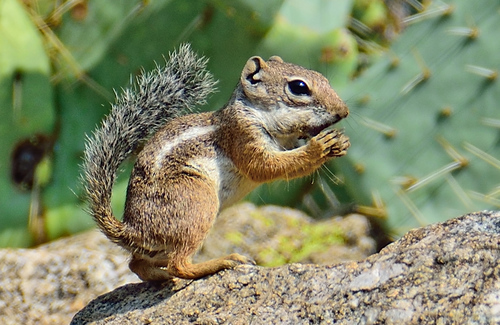
Harris' Antelope Squirrel
Ammospermophilus harrisii
A master of desert survival, the Harris' Antelope Squirrel thrives in the heat of the Sonoran Desert. With its striking side stripes and bushy tail, this energetic rodent is a favorite for backyard observers in the Southwest.
Quick Identification
Size
Total length of 22-25 cm (8.7-9.8 in); weight ranges from 115-150 g (4-5.3 oz)
Colors
Grizzled salt-and-pepper gray or brown upper body with a single white stripe on each side; creamy white underbelly; tail is gray with black and white frosting
Key Features
- Single white stripe on each flank, stopping before the face
- Small, rounded ears and a bushy tail often arched over the back
- Grizzled gray-brown coat that blends with desert soil
- White eye-ring without facial stripes
When You’ll See Them
Geographic range
Where Does the Harris' Antelope Squirrel Live?
The Harris' Antelope Squirrel is a quintessential resident of the Sonoran Desert, primarily occupying the arid reaches of the southwestern United States and northwestern Mexico. Its native range is concentrated heavily throughout southern and central Arizona, extending slightly into the extreme southwestern corner of New Mexico. South of the border, it is found extensively throughout the state of Sonora, Mexico, where it thrives in sun-baked landscapes that few other mammals can tolerate year-round.
Basemap © OpenStreetMap contributors
Behavior
The Harris' Antelope Squirrel is a diurnal desert specialist, meaning it is most active during the daylight hours when many other desert mammals are hiding from the sun. They are renowned for their incredible heat tolerance. When temperatures soar, these squirrels engage in a unique behavior called "heat dumping," where they find a patch of shade, stretch their bodies out flat against the cooler earth, and allow their body heat to dissipate into the ground.
Unlike many other squirrels, they do not hibernate and remain active year-round. They are largely solitary but highly alert, often seen perched on a rocky lookout or a low cactus arm to scan for predators like hawks or snakes. When startled, they let out a high-pitched, metallic trill and scurry away with their tails arched over their backs, showing off the grayish underside of the tail.
While they are primarily ground-dwellers, they are agile climbers and will frequently scale prickly pear cacti to reach fruit and pads. In suburban settings, they are curious but cautious, often darting between xeriscaped bushes or taking advantage of bird feeders that spill seeds onto the ground.
EverydayEarth exclusive
Camera Tips
To capture the best footage of a Harris' Antelope Squirrel, place your camera very low to the ground—ideally no more than 6 to 12 inches high. These are small animals, and a high-angle shot will lose the detail of their side stripes and expressive faces. Aim the camera toward a flat rock or a cleared patch of desert soil near the base of a prickly pear cactus or creosote bush, as these are natural foraging hubs.
Because they are extremely fast and prone to "stop-and-go" movement, set your camera to a fast trigger speed and a high-frame-rate video mode if possible. A "burst mode" for photos is also highly effective. Since they are active in the brightest parts of the day, ensure your camera has a wide dynamic range to handle the harsh desert sun and deep shadows without blowing out the white stripes on their fur.
To lure them into the frame, a small handful of black oil sunflower seeds or a piece of cut prickly pear fruit works wonders. If you are in a particularly dry area, a shallow water dish (drip-proof) is an irresistible attractant for these squirrels, especially during the pre-monsoon heat of June. Position the water in a spot that receives morning light for the most vibrant, clear images.
Watch for their "heat dumping" behavior during the hottest months. If you place your camera in a consistently shaded area under a rock overhang or a dense shrub, you may capture rare footage of the squirrel spread-eagled on the ground. This behavior makes for a much longer, more stable recording than their usual frantic dashing.
Similar Species
Species that look similar or are commonly confused with Harris' Antelope Squirrel.
White-tailed Antelope Squirrel
The underside of its tail is pure white, and it is generally found in slightly higher elevations or more northern desert regions.
Round-tailed Ground Squirrel
Lacks the white side stripes entirely and has a thinner, more cylindrical tail and a more uniform sandy-brown color.
Cliff Chipmunk
Features stripes on its face as well as its body, whereas the Harris' Antelope Squirrel has a plain face.
Frequently Asked Questions
Record Harris' Antelope Squirrel at your habitat
Connect a camera to start building your own species record — AI identifies every visitor automatically.