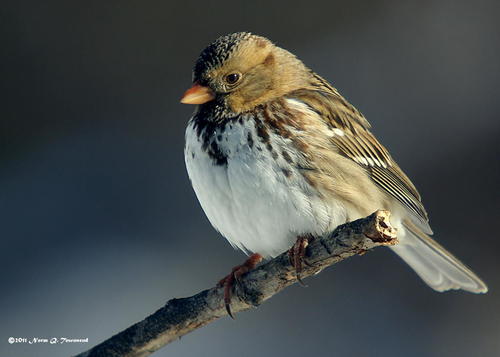
Harris's Sparrow
Zonotrichia querula
Meet Canada's only endemic breeding bird and the king of the Great Plains winter thickets. With its bold black mask and pink bill, Harris's Sparrow is a striking and sophisticated guest at any backyard feeder.
Quick Identification
Size
Length: 17–20 cm (6.7–7.9 in), Wingspan: 26 cm (10.2 in), Weight: 26–49 g (0.9–1.7 oz)
Colors
Distinctive black crown, face, and throat bib; pink bill; gray cheeks; white belly with dark streaking on the flanks; brown and black streaked back
Key Features
- Large black bib and crown extending to the face
- Stout, bubblegum-pink bill
- White underparts with dark-streaked flanks
- Large size for a sparrow, often appearing 'chesty'
When You’ll See Them
Geographic range
Where Does the Harris's Sparrow Live?
Native exclusively to North America, the Harris's Sparrow holds the unique distinction of being Canada's only endemic breeding bird, nesting in the stunted forests of the far north. During the winter months, these hardy travelers migrate south into the heart of the United States, establishing a core wintering range within the Great Plains from southern South Dakota down through Oklahoma and central Texas. They are rarely found far east or west of this central corridor, making them a special treat for birdwatchers in the American Midwest.
Basemap © OpenStreetMap contributors
Behavior
Harris's Sparrows are social and gregarious birds, particularly during the winter months when they form loose flocks. They spend much of their time on the ground, scratching through leaf litter with a distinctive double-scratch hopping motion to uncover seeds and insects. Within these flocks, they maintain a strict social hierarchy; older birds with the largest black bibs typically dominate younger, paler individuals at food sources.
While they are relatively shy compared to House Sparrows, they are frequent visitors to backyard feeders in the Great Plains. They are known for their mournful, thin whistling songs which can often be heard on cold winter mornings. When startled, they tend to fly upward into dense brush or thickets rather than flying away into the open, relying on cover for safety.
EverydayEarth exclusive
Camera Tips
To capture the best footage of Harris’s Sparrows, position your camera low to the ground, ideally 12 to 18 inches high. Since these are ground-foraging birds, they are most likely to visit areas with natural leaf litter or brush piles. Aim your camera toward a small clearing near a dense thicket; they prefer to stay close to cover and will frequently 'dash' out for seeds before retreating to the safety of the branches.
Ground-level tray feeders or 'platform' feeders are the most effective way to lure this species into your camera's frame. Fill your tray with white proso millet, cracked corn, or black oil sunflower seeds, as Harris’s Sparrows are specifically attracted to these high-energy winter foods. If you are using an AI-powered camera, ensure the motion sensitivity is set to high, as their ground-scratching behavior is fast and rhythmic.
The best time to record these sparrows is during the 'golden hours' of early morning. During mid-winter, they are most active between 7:00 AM and 10:00 AM when they are refueling after a cold night. Because they travel in flocks, you can often capture interesting social interactions; look for 'displacement' behavior where a bird with a larger black bib pushes a smaller bird away from the best feeding spot.
In late spring, just before they migrate north, their plumage becomes much more striking and their black bibs darken. This is the ideal time to switch your camera to high-definition video mode to capture their mournful, high-pitched whistling songs, which are quite distinct from other sparrow species.
Similar Species
Species that look similar or are commonly confused with Harris's Sparrow.
White-crowned Sparrow
Lacks the black throat bib and has a striped black-and-white crown rather than a solid black one.
House Sparrow
Much smaller with a dark bill; lacks the pink bill and extensive black facial plumage of the Harris's Sparrow.
Golden-crowned Sparrow
Has a yellow crown patch and lacks the solid black bib and face of the Harris's Sparrow.
Frequently Asked Questions
Record Harris's Sparrow at your habitat
Connect a camera to start building your own species record — AI identifies every visitor automatically.