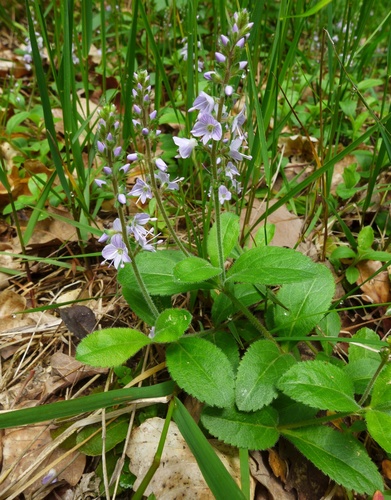
heath speedwell
Veronica officinalis
A resilient traveler from the old world, heath speedwell paints the ground in delicate shades of lilac and blue. This low-growing perennial is a master of survival, turning dry, acidic patches of your yard into a bustling hub for native pollinators.
Quick Identification
Size
Creeping stems 10-40 cm (4-16 inches) long; flower spikes reach 5-20 cm (2-8 inches) in height.
Colors
Pale lilac or lavender-blue flowers with distinct dark violet veins; stems and oval leaves are a soft grayish-green due to fine hairs.
Key Features
- Prostrate, hairy stems that root at the nodes
- Oval, finely-toothed leaves in opposite pairs
- Dense spikes of 4-lobed flowers with two protruding stamens
- Small, flattened, heart-shaped seed pods
When You’ll See Them
Behavior
The plant blooms sequentially from late spring through mid-summer. The flowers on each spike open from the bottom up, ensuring a prolonged period of availability for pollinators. During the night or in heavy rain, the small blossoms may close slightly to protect their pollen. In the winter, the plant remains somewhat evergreen in milder climates, though it goes dormant in colder regions, waiting for the first signs of spring to send out new hairy shoots.
EverydayEarth exclusive
Camera Tips
To successfully capture heath speedwell on a backyard or trail camera, you need to think low. Because this plant rarely exceeds 8 inches in height, your camera should be mounted on a ground stake or a very low tripod. Angle the lens slightly upward to catch the full profile of the flower spikes against the sky or a contrasting background. If your camera has a macro mode or a close-focus lens, this is the perfect time to use it, as the intricate violet 'veins' on the petals are the plant's most stunning feature.
Time-lapse is the best setting for this species. Set your camera to take a photo every 30 minutes during the daylight hours of June and July. This will allow you to see the 'climbing bloom' effect as the flowers open progressively up the stalk over several days. Because the flowers are sensitive to light and weather, time-lapse also captures the fascinating way the petals react to the morning sun and evening shade.
Since heath speedwell is a magnet for small pollinators like hoverflies, small carpenter bees, and occasional butterflies, use a high-speed motion trigger if your camera supports it. Position the camera about 12-18 inches away from a healthy cluster of blooms. To ensure the AI detection picks up movement, clear away any tall blades of grass that might sway in the wind and cause 'false' triggers, leaving the focus entirely on the speedwell and its insect visitors.
Lighting is crucial for this species. The pale lilac color can easily appear washed out in direct midday sun. The best images are usually captured during the 'golden hours' of early morning or late afternoon when the light is soft and directional. This side-lighting emphasizes the hairy texture of the leaves and stems, which is a key identifying characteristic of Veronica officinalis.
Similar Species
Species that look similar or are commonly confused with heath speedwell.
Frequently Asked Questions
Record heath speedwell at your habitat
Connect a camera to start building your own species record — AI identifies every visitor automatically.