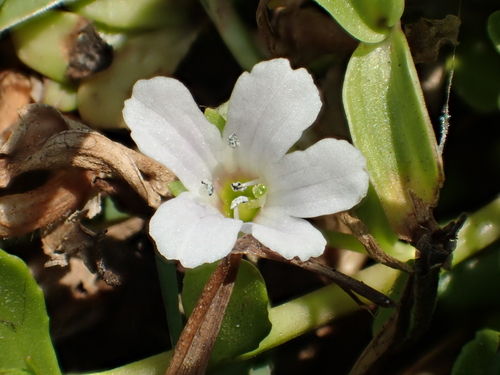
Herb-of-Grace
Bacopa monnieri
A lush, succulent groundcover that thrives where other plants drown, Herb-of-Grace brings delicate white blooms and therapeutic history to the muddy edges of your backyard.
Quick Identification
Size
Creeping stems 10-30 cm (4-12 in) long; individual leaves 1-2 cm (0.4-0.8 in) long.
Colors
Bright lime-green succulent leaves; small white, pale blue, or light purple flowers often with yellow centers.
Key Features
- Succulent, spoon-shaped leaves arranged in opposite pairs
- Small, five-petaled bell-shaped flowers
- Prostrate, creeping growth habit that roots at the nodes
- Fleshy, smooth stems that thrive in mud or water
When You’ll See Them
Loading activity data...
Behavior
Herb-of-Grace, often known as Brahmi, is a resilient perennial herb that acts as a living carpet in damp environments. Unlike many garden plants that shy away from standing water, this species thrives in boggy conditions, spreading through horizontal runners that root whenever they touch moist earth. This creeping behavior allows it to form dense, lush mats that stabilize soil along pond edges and provide cover for tiny aquatic creatures.
While it is famous in herbal traditions for its cognitive-boosting properties, in the backyard ecosystem, it serves as a vital groundcover. Its flowers are modest but attractive to small pollinators. The plant is highly sensitive to moisture levels; during dry spells, it may appear wilted or stagnant, but it quickly rebounds and expands its footprint the moment water returns to the area.
EverydayEarth exclusive
Camera Tips
Capturing Herb-of-Grace on camera requires a shift from traditional wildlife tracking to botanical time-lapse photography. Because this plant is a low-growing groundcover, mount your camera on a low-profile stake or a specialized ground-level tripod only 6 to 12 inches off the earth. Angle the lens slightly downward to capture the spreading pattern of the succulent mats. If your AI camera has a macro-focus mode, use it to highlight the delicate five-petaled flowers, which are often less than half an inch wide.
For the most engaging results, set your camera to a time-lapse interval (e.g., one photo every 30 minutes) during the peak growing season. This allows you to witness the plant 'creeping' across the mud over several weeks. Position the camera near the edge of a water feature where the plant is likely to expand. This setup also provides a secondary benefit: Herb-of-Grace mats are popular hunting grounds for frogs and watering spots for pollinators, so your camera is likely to trigger on these visitors as well.
Lighting is crucial for this species. Try to place your camera so it is not facing directly into the midday sun, which can wash out the vibrant green of the fleshy leaves. Instead, aim for a spot that receives bright, filtered light. If you are using a trail cam to monitor growth, ensure the area is cleared of taller grasses that might blow in the wind and cause false triggers. In autumn, keep the lens clear of fallen leaves that might bury the low-lying plant and obscure your view.
Similar Species
Species that look similar or are commonly confused with Herb-of-Grace.
Marsh Pennywort
Marsh Pennywort has round, peltate leaves with the stem attached to the center, rather than the opposite-paired succulent leaves of Herb-of-Grace.
Creeping Charlie
Creeping Charlie has scalloped, heart-shaped leaves that are not succulent, and it produces much larger, hooded purple flowers.
Frequently Asked Questions
Record Herb-of-Grace at your habitat
Connect a camera to start building your own species record — AI identifies every visitor automatically.