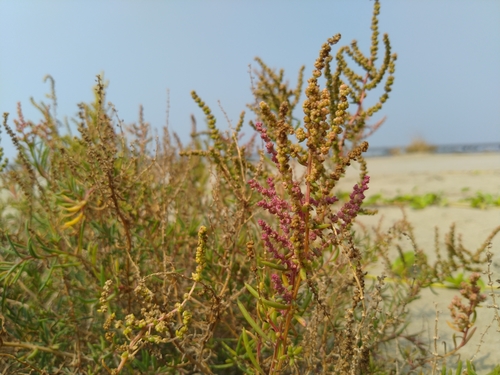
Herbaceous Seepweed
Suaeda maritima
A resilient coastal pioneer that paints salt marshes in hues of emerald and crimson. Discover the fascinating life of the Herbaceous Seepweed, the succulent survivor of the shoreline.
Quick Identification
Size
Typically 10-50 cm (4-20 inches) in height; can spread horizontally up to 40 cm (16 inches)
Colors
Bright green to glaucous blue-green succulent leaves; transitions to deep red, orange, or purple in late autumn
Key Features
- Succulent, cylindrical leaves
- Prostrate or erect growth habit
- Leaves turn brilliant red in late season
- Inconspicuous green flowers nestled in leaf bases
When You’ll See Them
Behavior
Herbaceous Seepweed is a master of coastal adaptation, thriving in the harsh, salty environment of mudflats and salt marshes where most plants would perish. As a halophyte, it has evolved specialized biological mechanisms to handle high salt concentrations, often storing excess salt in its fleshy, succulent leaves. When the salt levels become too high, the plant may shed these leaves, effectively 'exhaling' the salt that would otherwise poison it.
While it is a stationary species, its growth pattern is highly responsive to its environment. It acts as a pioneer plant, often the first to colonize bare, salty patches of earth. These dense mats of vegetation provide a vital service to the ecosystem by stabilizing shifting coastal soils and providing a 'nursery' canopy for tiny salt-marsh invertebrates. Throughout its life cycle, it changes from a functional green during the summer growing season to a vivid palette of reds and purples in the autumn, signaling its preparation to drop seeds for the following year.
EverydayEarth exclusive
Camera Tips
Capturing the beauty of Herbaceous Seepweed requires a shift in perspective compared to mobile wildlife. To truly showcase its architectural structure, mount your camera on a low-profile ground stake or use a beanbag mount at soil level. This low-angle 'worm's eye view' transforms a small patch of seepweed into an alien-looking forest of succulents, especially when the tide is out and the textures of the mud are visible in the background.
For AI-powered cameras, use a macro lens or a close-focus setting if your hardware allows. The flowers of the Herbaceous Seepweed are tiny and inconspicuous, but a sharp close-up can reveal the delicate structure of the stamens and the crystalline texture of the salt-storing leaves. Because this plant lives in the intertidal zone, ensure your camera housing is salt-spray resistant and securely anchored to a permanent structure or a heavy stake to prevent it from being swept away during high spring tides.
Time-lapse is your best tool for this species. Set your camera to take a photo every 30 minutes over the course of several weeks in late August through October. This will allow you to create a stunning visual record of the plant's 'blushing'—the chemical transition from green to deep crimson. Additionally, shorter time-lapses during a single tidal cycle can capture the mesmerizing way the plants are submerged by the sea and then emerge dripping as the tide retreats.
Since Seepweed is a hub for small insects, crabs, and snails, keep an eye on your camera's motion-triggered logs. While the plant itself won't trigger a motion sensor, the ladybugs and beetles that hunt within its branches often will. Adjust your sensitivity settings to high if you are interested in capturing the micro-interactions of the wildlife that calls this plant home. Position the camera facing toward the sun during the 'golden hour' to highlight the translucent, gem-like quality of its succulent leaves.
Similar Species
Species that look similar or are commonly confused with Herbaceous Seepweed.
Frequently Asked Questions
Record Herbaceous Seepweed at your habitat
Connect a camera to start building your own species record — AI identifies every visitor automatically.