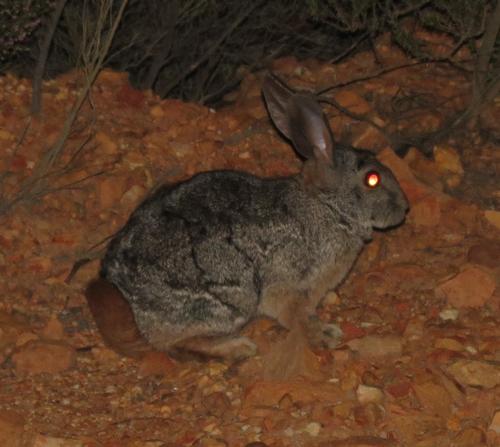
Hewitt's Red Rockhare
Pronolagus saundersiae
A master of the mountain peaks, Hewitt's Red Rockhare is a shy but striking inhabitant of the Southern African crags. With its rich rufous fur and incredible agility, this rocky specialist is a hidden gem of the high country.
Quick Identification
Size
Length: 38–53 cm (15–21 inches); Weight: 1.3–2.5 kg (2.9–5.5 lbs)
Colors
Densely furred rufous and grayish-brown upperparts; creamy-white to buff underparts; dark brown or blackish bushy tail
Key Features
- Distinctive rufous (reddish) fur tone
- Large, furry ears with dark-fringed tips
- Stocky build with powerful hind legs for climbing
- Short, dark, bushy tail
When You’ll See Them
Geographic range
Where Does the Hewitt's Red Rockhare Live?
Native to the southernmost tip of Africa, Hewitt's Red Rockhare is found in the rugged mountainous regions of South Africa, Lesotho, and Eswatini. It is most frequently encountered along the Great Escarpment and the fold mountains of the Eastern and Western Cape. While it is a habitat specialist restricted to rocky elevations, it is well-established across its native range and does not have any known introduced populations elsewhere.
Basemap © OpenStreetMap contributors
Behavior
Hewitt's Red Rockhare is an elusive, primarily nocturnal mammal that has mastered the art of living in vertical landscapes. Unlike many other members of the rabbit family that prefer flat plains, these rockhares are agile climbers, using padded paws to grip steep stone surfaces. They spend their daylight hours hidden deep within the cool recesses of rocky crevices or beneath large boulders, emerging only as dusk falls to forage.
Socially, they are somewhat solitary but can be found in small groups where habitat is ideal. They are highly territorial over their rocky outcrops and communicate through a series of high-pitched whistles, which serve as an alarm system for the community. When a predator like a leopard or eagle is spotted, the rockhare will emit a sharp cry before vanishing instantly into a crack in the rock.
Interactions with humans are rare due to their shy nature and specific habitat requirements. However, in suburban areas that abut mountain ranges—such as parts of the Eastern Cape—they may venture into gardens at night to graze on manicured lawns, though they remain extremely skittish and will flee at the slightest movement.
EverydayEarth exclusive
Camera Tips
To capture the Hewitt's Red Rockhare, you must think vertically. The most effective strategy is to locate 'latrine sites'—communal areas on flat rocks where these hares leave piles of small, round droppings. Placing your camera 1-2 meters away from these sites, angled slightly downward, is almost a guarantee for a clear shot, as they return to these spots nightly.
Set your camera low to the ground, about 20-30 cm (8-12 inches) high. Because these animals are strictly nocturnal, a camera with high-quality infrared (No-Glow) LEDs is essential to avoid startling them. They have excellent hearing and vision; a visible white flash will likely ensure you only get one photo before they relocate their foraging path.
Trigger speed is another critical factor. Rockhares move with sudden, jerky bursts of speed when navigating boulders. A camera with a trigger speed of 0.3 seconds or faster will prevent you from getting 'ghost' shots of a disappearing tail. If your camera supports a 'burst mode,' set it to take 3-5 photos per trigger to capture their unique hopping gait.
During the dry season, a small, shallow water basin placed near a rock pile can be an irresistible lure. While they don't respond to traditional baits like carrots or fruit, they will go out of their way for a reliable water source. Ensure the camera is positioned to capture the area between the rocks and the water, as they will often pause to scan for predators before drinking.
Similar Species
Species that look similar or are commonly confused with Hewitt's Red Rockhare.
Smith's Red Rockhare
Very similar in appearance but slightly smaller on average; prefers more arid, northerly rocky habitats.
Natal Red Rockhare
Significantly larger with a more rufous-colored tail and a preference for higher rainfall areas.
Cape Hare
Found in open plains rather than rocks; has much longer ears and legs and lacks the deep reddish fur of the rockhares.
Frequently Asked Questions
Record Hewitt's Red Rockhare at your habitat
Connect a camera to start building your own species record — AI identifies every visitor automatically.