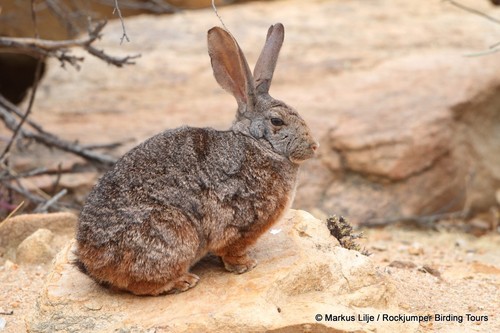
Smith's Red Rockhare
Pronolagus rupestris
The Smith's Red Rockhare is a specialized mountain-dweller that trades the open plains for the safety of the stones. Smaller and redder than its cousins, this agile mammal is the ultimate prize for backyard observers living in Africa's rugged landscapes.
Quick Identification
Size
Total length 38-54 cm (15-21 in); weight 1.3-2.5 kg (2.9-5.5 lbs)
Colors
Rich reddish-brown upperparts with a grizzled texture; white to tawny underbelly; greyish-white chin and throat collar; bushy reddish-brown tail with a darker tip.
Key Features
- Smallest member of the red rockhare genus
- Short, rounded ears compared to typical hares
- Thick, woolly reddish-brown fur
- Bushy tail used for signaling
- Large hind legs built for jumping between rocks
When You’ll See Them
Behavior
Smith's Red Rockhare is a shy and elusive mammal that leads a specialized lifestyle among rocky outcrops and stone-strewn hillsides. Unlike the more common scrub hares that favor open grasslands, this species is a master of the 'kopje' (rocky hill), using crevices and boulders as its primary defense against predators. They are extremely agile, capable of making vertical leaps and tight turns on uneven stone surfaces that would trip up many of their pursuers.
Primarily solitary, they are most active during the cooler hours of the night and twilight. They are known for their habit of using communal latrines or 'middens,' which are specific locations where multiple individuals leave droppings. This behavior is a goldmine for wildlife observers as it provides a predictable spot to monitor their presence in a territory. While they are usually silent, they can emit a shrill scream when threatened or captured.
Interactions with humans are rare due to their specialized habitat and nocturnal nature. However, for those living on the urban-wildlife interface near mountain ranges or rocky ridges, these rockhares can become frequent visitors to gardens that offer lush grasses or succulents. They are generally harmless to property but can be quite skittish, bolting back to their rocky fortresses at the slightest sound of a door opening.
EverydayEarth exclusive
Camera Tips
To capture high-quality footage of Smith's Red Rockhare, your primary goal is location scouting rather than luring. Look for 'middens'—accumulations of small, round, flattened droppings—amongst rocky outcrops. These rockhares are creatures of habit and will return to these spots consistently. Position your camera about 30 cm (12 inches) off the ground, angled slightly downward toward the center of the midden or a well-worn path between two large boulders.
Because these animals are most active in low-light conditions, a camera with a high-quality infrared (no-glow) flash is essential. Standard white flashes will likely spook them and prevent them from returning to the frame. Set your camera to 'Burst Mode' or a short video clip (15-20 seconds) with a fast trigger speed. They move with sudden, jerky motions, and a slow camera will often result in a 'ghost' image or a frame with nothing but a disappearing tail.
While they are naturally wary of baits, you can encourage them to linger in front of the lens by placing a mineral salt lick or a small patch of fresh lucerne (alfalfa) near a rock crevice they use for cover. Ensure the bait is positioned so the hare is forced to turn its side to the camera, giving you a clear view of its distinctive reddish flanks and rounded ears. Avoid placing cameras in high-wind areas on ridges, as the moving vegetation can cause false triggers and the hares tend to stay in the lee of the rocks when it's breezy.
Seasonally, the best time for activity is during the breeding season from September to February. During this time, you may capture more social interactions or the rare sight of a mother with a single leveret. If you are monitoring a backyard garden that borders rocky terrain, focus your camera on the transition zone where the rocks meet the lawn; this is where they are most likely to pause and scan for danger before emerging to feed.
Similar Species
Species that look similar or are commonly confused with Smith's Red Rockhare.
Natal Red Rockhare
Larger than Smith's and typically lacks the greyish-white chin, with a more uniform reddish coloration.
Scrub Hare
Much longer ears with black tips and longer hind legs; prefers open grasslands rather than rocky outcrops.
Jameson's Red Rockhare
Occupies a more northern range and has a slightly more yellowish-brown tone to its fur compared to the deep red of Smith's.
Frequently Asked Questions
Record Smith's Red Rockhare at your habitat
Connect a camera to start building your own species record — AI identifies every visitor automatically.