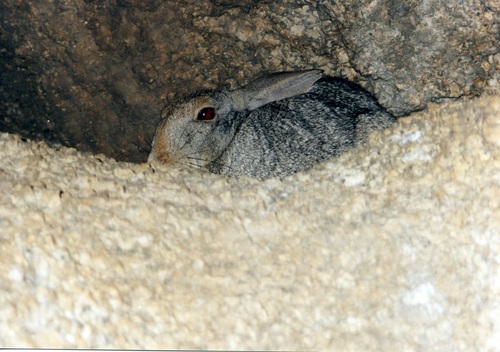
Jameson's Red Rockhare
Pronolagus randensis
A master of the southern African stone landscapes, Jameson's Red Rockhare is an agile nocturnal specialist. With its rich rufous fur and incredible leaping ability, it is one of the most unique mammals to discover in rocky backyard environments.
Quick Identification
Size
Length: 42-50 cm (16.5-19.7 in); Weight: 1.82-2.95 kg (4.0-6.5 lbs)
Colors
Rich rufous and brown grizzled upperparts with paler buff-colored underparts; distinctive reddish-brown bushy tail.
Key Features
- Bushy reddish-brown tail
- Long greyish ears
- Coarse woolly fur with rufous highlights
- Nervous, high-speed movement over rocky terrain
When You’ll See Them
Geographic range
Where Does the Jameson's Red Rockhare Live?
Jameson's Red Rockhare is native to the southern African continent, specifically adapted to its fragmented rocky landscapes. Its core range spans the central and eastern regions of South Africa, much of Zimbabwe, and parts of eastern Botswana, extending further into the arid hills of Namibia, Angola, and western Mozambique. It is almost exclusively found where suitable rocky terrain exists, making its distribution patchy across these countries.
Basemap © OpenStreetMap contributors
Behavior
Jameson's Red Rockhares are strictly nocturnal specialists of the rugged, boulder-strewn landscapes of Southern Africa. During the daylight hours, they remain well-hidden within deep rock crevices, caves, or beneath massive granite slabs to avoid predators and the African sun. They emerge only under the cover of darkness to forage on nearby grasses, always remaining close to their rocky refuges for a quick escape.
These hares are remarkably agile, capable of navigating near-vertical stone surfaces and leaping between rocks with precision that rivals mountain goats. While they are largely solitary, they are not strictly territorial and may congregate in areas where grazing is particularly lush. When threatened, they often 'freeze' to utilize their camouflage before bolting with a characteristic piercing alarm whistle that alerts other rockhares in the area.
EverydayEarth exclusive
Camera Tips
To successfully capture Jameson's Red Rockhare on camera, you must focus your efforts on the 'kopjes' or rocky outcrops where they reside. Look for their distinct latrine sites—flat rock surfaces covered in small, round droppings—as these animals are creatures of habit and frequently return to the same spots. Positioning your camera near these sites or along the narrow 'runs' or paths that lead from the rocks into the surrounding grass increases your chances significantly.
Mount your camera at a low height, approximately 20 to 30 centimeters (8-12 inches) off the ground. Because these hares are entirely nocturnal, a camera with a high-quality, 'no-glow' infrared flash is essential to avoid spooking them, as they are notoriously skittish. Set your camera to take bursts of photos or short videos, as they often move in quick, erratic dashes between cover.
The best time for activity is usually the first few hours after sunset and the twilight hours just before dawn. If your property includes a transition zone where a rocky slope meets a lawn or natural grassland, place the camera there. During the dry season, they may spend more time foraging in specific green patches, making those areas prime real estate for a trail camera setup.
Similar Species
Species that look similar or are commonly confused with Jameson's Red Rockhare.
Natal Red Rockhare
Slightly larger and heavier, the Natal species prefers more humid, higher-rainfall areas further east.
Smith's Red Rockhare
Generally smaller with slightly different ear coloration, found mostly in the more arid southern and central parts of South Africa.
Scrub Hare
Lacks the rufous coloring, has much longer ears, and is found in open grasslands rather than rocky outcrops.
Frequently Asked Questions
Record Jameson's Red Rockhare at your habitat
Connect a camera to start building your own species record — AI identifies every visitor automatically.