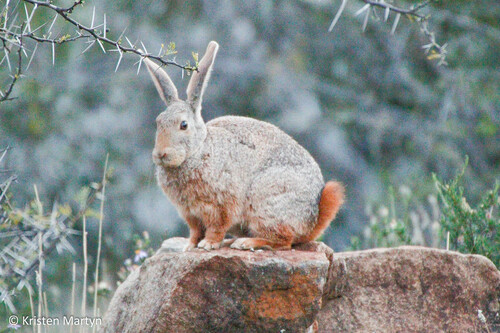
Natal Red Rockhare
Pronolagus crassicaudatus
A specialist of the Southern African highlands, the Natal Red Rockhare is a reclusive beauty with a vibrant rufous coat. Watch for this agile jumper as it emerges from the shadows of rocky cliffs under the cover of night.
Quick Identification
Size
Length: 42-50 cm (16.5-19.7 in); Weight: 1.8-3.0 kg (4.0-6.6 lbs)
Colors
Grizzled grayish-brown head and face; vibrant reddish-brown (rufous) upperparts and rump; pale underparts; tail is a bushy dark brown or reddish.
Key Features
- Thick, dense, and slightly rough fur
- Short, rounded ears compared to typical field hares
- Large, bushy rufous tail
- Strongly built hindquarters for leaping between rocks
When You’ll See Them
Behavior
The Natal Red Rockhare is a master of the vertical world, far more at home on a steep, boulder-strewn hillside than in an open field. Unlike the more common scrub hares that rely on speed across flat ground, these 'rock rabbits' use their powerful hind legs to navigate treacherous kranzes (cliffs) and rocky outcrops. They are incredibly shy and secretive, usually spending their daylight hours tucked away in deep rock crevices or under thick brush to avoid predators like eagles and leopards.
When evening falls, they emerge to feed on the grasses surrounding their rocky fortresses. While they are primarily solitary, you might occasionally see small groups congregating in prime feeding spots, though they rarely stray far from the safety of the rocks. If startled, they emit a piercing, high-pitched whistle as an alarm before vanishing into the shadows with a series of agile, bounding leaps.
EverydayEarth exclusive
Camera Tips
Capturing a Natal Red Rockhare on camera requires understanding their specific 'rock-hugging' lifestyle. The most effective way to find them is to locate their 'latrine' sites. These hares are creatures of habit and consistently use the same flat rocks or cleared areas as communal dung middens. If you find a cluster of small, flattened organic pellets on a prominent rock, place your camera nearby—this is a high-traffic zone they will visit nightly.
Because they live in rugged terrain, camera placement is tricky. Mount your camera low to the ground, roughly 12-18 inches high, but ensure it is angled slightly upward if you are placing it at the base of a slope. These hares move quickly and with a jerky, bounding motion, so set your camera to 'Burst Mode' or 'Photo + Video' with the fastest possible trigger speed. A high-quality infrared (no-glow) flash is essential, as standard white flashes will startle them and likely prevent them from returning to that spot for several nights.
Focus your efforts on the transition zones where rocky cover meets grassy patches. These are their primary foraging grounds. If your backyard borders a rocky ridge or hill, place the camera along the narrow 'runs' or paths that lead from the rocks down to the grass. You don't necessarily need bait, as their movements are highly patterned, but a small patch of freshly watered, succulent grass can sometimes act as a natural lure during the drier winter months.
Finally, be mindful of the wind. Since they are extremely sensitive to scent and sound, try to service your camera during the hottest part of the day when they are deep under rock cover. Use a wide-angle lens setting if your camera allows it, as this helps capture the hare even if it doesn't walk directly in front of the sensor while navigating the uneven terrain.
Similar Species
Species that look similar or are commonly confused with Natal Red Rockhare.
Smith's Red Rockhare
Smaller with a more yellowish-red tint, found in the more arid central and western parts of South Africa.
Scrub Hare
Much larger ears, longer legs, and prefers open savanna or scrubland rather than rocky cliffs.
Hewitt's Red Rockhare
Very similar in appearance but restricted to a small range in the eastern parts of the Karoo.
Frequently Asked Questions
Record Natal Red Rockhare at your habitat
Connect a camera to start building your own species record — AI identifies every visitor automatically.