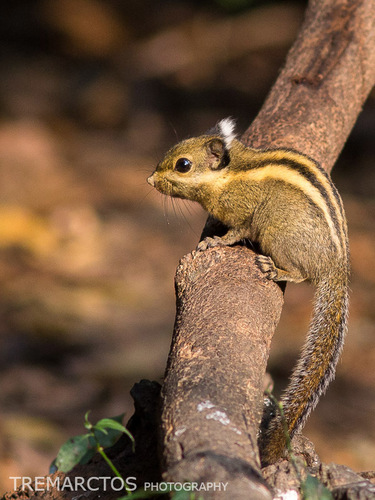
Himalayan Striped Squirrel
Tamiops mcclellandii
With its racing-stripe markings and charming white ear tufts, the Himalayan Striped Squirrel is one of Asia's most charismatic canopy dwellers. This tiny, energetic rodent turns any backyard into a bustling aerial playground.
Quick Identification
Size
Head-body length of 10–15 cm (4–6 in) and a tail length of 11–14 cm (4.5–5.5 in); weight ranges from 40–85 g (1.4–3 oz).
Colors
Olive-brown or grayish-brown base; five dark longitudinal stripes alternating with four pale buff stripes; white tufts at the tips of the ears; yellowish-orange or buff underbelly.
Key Features
- Five dark dorsal stripes with a prominent black central line
- Distinctive white tufts on the ear tips
- Long, slender tail that is often held vertically while foraging
- Tiny, mouse-like proportions but with clear squirrel features.
When You’ll See Them
Geographic range
Where Does the Himalayan Striped Squirrel Live?
The Himalayan Striped Squirrel is native to the vast, mountainous regions of South and Southeast Asia. Its core range extends from the eastern Himalayan foothills in Nepal, Bhutan, and Northeast India, stretching eastward through Myanmar, Thailand, Laos, Cambodia, and Vietnam. It is also commonly found in the southern Chinese provinces, particularly Yunnan, where it thrives in both high-altitude forests and lush lowland valleys.
Basemap © OpenStreetMap contributors
Behavior
The Himalayan Striped Squirrel is a highly energetic and arboreal species, spending the vast majority of its time in the forest canopy or among the branches of garden trees. Unlike many larger squirrels that move with fluid leaps, these small rodents have a characteristic 'jerky' movement, darting quickly from one spot to another and frequently pausing to survey their surroundings. They are social creatures and are often seen foraging in pairs or small family groups, maintaining contact with high-pitched, bird-like chirps that can easily be mistaken for avian calls by the untrained ear.
During the day, they are incredibly industrious, spending hours searching for food. While they are wary of predators, they have adapted remarkably well to human presence, especially in areas where fruit trees or bird feeders are present. They do not hibernate, remaining active throughout the year, though they may retreat to their nests—usually globular structures made of moss and leaves tucked into tree hollows—during particularly heavy monsoon rains or cold mountain snaps.
EverydayEarth exclusive
Camera Tips
To capture the Himalayan Striped Squirrel, elevation is key. These squirrels are strictly arboreal, so placing your camera at ground level will likely result in missed shots or blurry tails. Instead, mount your camera 5 to 10 feet up a tree trunk, preferably one with rough bark or vines that they use as 'highways.' Angle the camera slightly downward to cover a horizontal branch where they might stop to feed. Because they move with lightning-fast, twitchy motions, set your camera to its fastest possible shutter speed or use a high-frame-rate video mode to avoid motion blur.
Baiting can be very effective for bringing them into the camera's focus zone. Smearing a small amount of honey or jam on a branch can encourage them to stop and lick, providing a perfect still-shot opportunity. Alternatively, a small dish of sunflower seeds or chopped fruit like mango or papaya secured to a branch works wonders. Since they are attracted to flowering trees, placing your camera near blossoms during the spring can capture them as they forage for nectar.
Timing is critical as they are most active in the early morning and late afternoon. Set your camera’s PIR sensor to high sensitivity, as these squirrels are small and may not trigger lower-sensitivity settings. If you are using a trail camera with a 'burst mode,' set it to take 3-5 photos per trigger; their rapid movements mean that out of a five-shot burst, you are likely to get at least one perfectly posed portrait where the white ear tufts are clearly visible.
Similar Species
Species that look similar or are commonly confused with Himalayan Striped Squirrel.
Frequently Asked Questions
Record Himalayan Striped Squirrel at your habitat
Connect a camera to start building your own species record — AI identifies every visitor automatically.