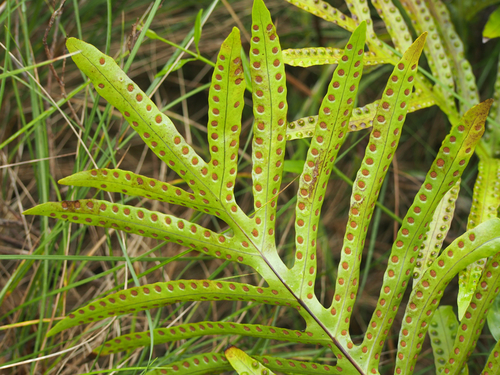
hound's tongue fern
Microsorum pustulatum
With its glossy, deeply lobed fronds and adventurous climbing habit, the hound's tongue fern brings a touch of prehistoric beauty to any garden. Whether it's scaling a tree trunk or blanketing a rockery, this resilient fern is a favorite sanctuary for backyard lizards and insects.
Quick Identification
Size
Fronds typically 15–50 cm (6–20 in) long; creeping rhizomes can spread over several meters.
Colors
Glossy emerald green fronds; creeping brown or blackish-scaled rhizomes; bright orange or rust-colored circular sori (spore cases).
Key Features
- Glossy, leathery texture to the touch
- Deeply lobed mature fronds that look like a kangaroo's footprint
- Prominent, raised orange sori on the frond underside
- Thick, fleshy rhizome that climbs trees or rocks
When You’ll See Them
Behavior
The hound's tongue fern is a versatile and hardy evergreen that doesn't just sit in the soil; it is an adventurous climber. Known as an epiphyte (growing on trees) or a lithophyte (growing on rocks), it uses its thick, scaly rhizomes to anchor itself and creep across surfaces. In a backyard setting, you will often see it winding its way up the trunks of tree ferns or old hardwoods, adding a lush, prehistoric layer to the garden canopy.
While it appears stationary, the fern is constantly interacting with its environment. It creates a complex microhabitat for small backyard residents. Its leathery fronds provide essential shelter for skinks and geckos, while the moist environment around its rhizomes is a favorite hunting ground for predatory insects and spiders. Unlike many delicate ferns, it is quite resilient to dry spells, making it a reliable feature of the Australasian landscape.
EverydayEarth exclusive
Camera Tips
Capturing the hound's tongue fern on your trail camera requires a different approach than moving wildlife. To get the best results, mount your camera on a tripod or a neighboring tree about 3 to 5 feet off the ground, angled slightly downward to capture the glossy texture of the fronds. Because this fern is a magnet for skinks and geckos, aim the lens at a patch where the sun hits the leaves in the morning; these cold-blooded visitors will often bask on the flat 'fingers' of the fern to warm up.
For those using AI-powered cameras, set your device to 'Time-Lapse' mode during the spring months. This allows you to witness the fascinating 'unrolling' of new croziers (fiddleheads) as they expand into mature, lobed fronds. If your camera has a macro setting or a close-focus lens, position it within 18 inches of the underside of a frond to capture the vibrant orange sori. These spore clusters are incredibly photogenic and provide a splash of color that contrasts beautifully with the green foliage.
Since this fern often grows in shaded areas, lighting can be a challenge. Try to position your camera so it faces away from the direct sun to avoid harsh highlights on the leathery, reflective surface of the leaves. Overcast days are actually your best friend for photographing this species, as the soft light brings out the deep emerald tones without causing the 'blowout' effect common with glossy plants. If your camera has adjustable triggers, set the sensitivity to high to catch the tiny insects—like leaf-cutter bees or beetles—that frequently visit the fern.
Similar Species
Species that look similar or are commonly confused with hound's tongue fern.
Frequently Asked Questions
Record hound's tongue fern at your habitat
Connect a camera to start building your own species record — AI identifies every visitor automatically.