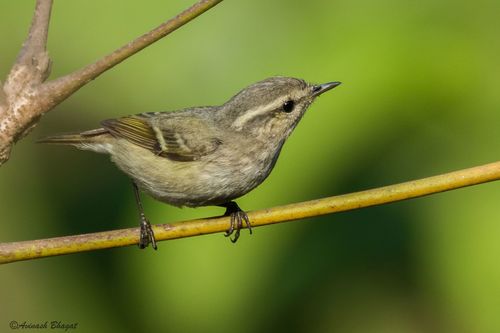
Hume's Leaf Warbler
Phylloscopus humei
A tiny, high-energy traveler from the mountains of Central Asia, Hume's Leaf Warbler is a master of the canopy. Known for its persistent whistling call and acrobatic foraging, this migratory gem is a seasonal highlight for backyard observers.
Quick Identification
Size
Length: 9–11 cm (3.5–4.3 in); Wingspan: 15–18 cm (6–7 in); Weight: 5–10 g (0.18–0.35 oz)
Colors
Dull olive-green upperparts and off-white to buff underparts. Notable for two pale yellowish-white wing bars and a long, prominent buff-colored eyebrow stripe.
Key Features
- Two pale wing bars, with the lower one being significantly more prominent
- Long, pale yellowish-white supercilium (eyebrow) reaching the back of the head
- Dark, thin bill with a pale base to the lower mandible
- Constant wing-flicking and tail-twitching while foraging
When You’ll See Them
Geographic range
Where Does the Hume's Leaf Warbler Live?
Hume's Leaf Warbler is a native of the vast mountain wilderness of Central Asia, breeding primarily across the Altai and Sayan ranges in Russia, Mongolia, and Northern China. As a strongly migratory species, it travels south for the winter to the Indian subcontinent, covering countries like India, Nepal, and Bangladesh, as well as parts of Southeast Asia. Interestingly, it is also a well-known 'vagrant' in Europe, where small numbers of these tiny birds are spotted every autumn as far west as the United Kingdom.
Basemap © OpenStreetMap contributors
Behavior
Hume's Leaf Warbler is an incredibly active and restless bird, characterized by its near-constant movement. It spends most of its daylight hours flitting through the canopy of trees or dense shrubbery, frequently flicking its wings and tail—a classic trait of the leaf warbler family. While foraging, it performs short, acrobatic hovering flights to snatch insects from the undersides of leaves or catches them mid-air in brief sallies.
Socially, they are often found alone or in small mixed-species foraging flocks during the winter months, joining other warblers, tits, and small insectivores. While they are not particularly shy around humans, their small size and preference for the mid-to-upper canopy can make them difficult to spot without the help of their distinctive, loud, two-note whistling call, which sounds like a sharp 'chee-we'.
EverydayEarth exclusive
Camera Tips
To capture a Hume's Leaf Warbler on your backyard camera, you need to focus on their pit stops. Because they are canopy-dwellers, they rarely descend to the ground except for one thing: water. A birdbath with a solar-powered dripper or a small moving fountain is your best chance. Position the camera about 3 to 5 feet away from the water source, ensuring it is level with the surface to capture the bird's reflection and fine plumage details during its quick bathing sessions.
Since these birds are extremely small and fast, standard trail camera settings often result in a blur. Use a high-speed trigger setting (0.2s or faster) and, if possible, set your camera to take 'Bursts' of 3-5 photos. This increases the chances of getting a clear shot of the diagnostic wing bars. If you are using a camera that records video, 60fps (frames per second) is highly recommended to slow down their rapid wing-flicking behavior in post-capture viewing.
Lighting is crucial for this species. Try to place your camera in an area that receives bright, filtered morning light. This will help highlight the subtle olive tones and the pale supercilium that distinguishes them from similar-looking warblers. In winter gardens, they often frequent trees infested with aphids or small scale insects; if you notice a particular tree where a small bird is constantly 'zip-zipping' through the leaves, that is the perfect spot to strap your camera to a nearby branch.
Similar Species
Species that look similar or are commonly confused with Hume's Leaf Warbler.
Frequently Asked Questions
Record Hume's Leaf Warbler at your habitat
Connect a camera to start building your own species record — AI identifies every visitor automatically.