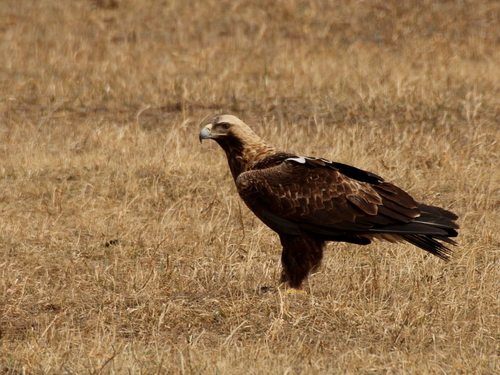
Imperial Eagle
Aquila heliaca
The monarch of the open steppe, the Imperial Eagle is a symbol of wild, untamed landscapes. With its golden crown and powerful gaze, this rare raptor is one of the most sought-after sightings for wildlife enthusiasts across Eurasia.
Quick Identification
Size
Length: 72–90 cm (28–35 in); Wingspan: 1.8–2.16 m (5.9–7.1 ft); Weight: 2.45–4.55 kg (5.4–10 lbs)
Colors
Adults are dark chocolate-brown with a golden-buff crown and nape, featuring distinctive white patches on the shoulders. Juveniles are much paler, tawny-brown with heavy streaking.
Key Features
- Distinctive white 'epaulette' patches on shoulders
- Pale golden-tawny crown and hindneck contrast with dark body
- Massive dark bill with a bright yellow cere at the base
- Broad wings with deeply slotted 'fingers' at the tips
- Heavy, feathered legs reaching down to the yellow feet
When You’ll See Them
Geographic range
Where Does the Imperial Eagle Live?
The Imperial Eagle is native to the vast temperate regions of the Palearctic, with breeding populations spanning from Central and Southeastern Europe across Russia and Central Asia to Lake Baikal. This species is a world traveler; most populations are migratory, spending their winters in the warmer reaches of Northeastern Africa, the Middle East, and across Southern and Eastern Asia. While they were once more widespread in Europe, their core modern strongholds remain in the steppes of Kazakhstan and Russia, with a small but vital population persisting in the Carpathian Basin.
Basemap © OpenStreetMap contributors
Behavior
The Imperial Eagle is a majestic and somewhat stoic predator, often seen spending long hours perched on high vantage points such as lone trees or power poles. From these heights, they survey their territory for movement, utilizing their incredible eyesight to spot prey from over a kilometer away. Unlike the more agile hawks, they are heavy fliers, relying on thermal updrafts to soar effortlessly over open plains with minimal wing flapping.
Socially, these eagles are typically found in monogamous pairs that defend large territories during the breeding season. They are notoriously sensitive to human presence, often abandoning nests if disturbed by forestry or agricultural activity. Despite their 'Imperial' name and fearsome appearance, they are opportunistic feeders and will frequently resort to scavenging carrion, especially during the winter months when their primary prey is less active.
EverydayEarth exclusive
Camera Tips
To capture an Imperial Eagle on a trail camera, you must focus on 'lookout' locations. These birds prefer isolated, tall trees that offer a 360-degree view of the surrounding plains or steppes. If you have access to such a tree on a rural property, mount your camera high on the trunk facing a sturdy, horizontal branch that shows signs of use (like droppings or 'whitewash'). Use a wide-angle setting to capture the bird's massive wingspan as it lands or takes off.
In wintering grounds, these eagles are much more likely to visit the ground. Placing a camera near a known carcass or a safe, legal baiting station (check local wildlife laws first) can provide stunning close-ups. Set your camera to a fast trigger speed—under 0.5 seconds—and use a high-speed burst mode (3-5 photos per trigger) to ensure you catch the moment their wings are fully spread, which is the most dramatic shot for this species.
Because Imperial Eagles are extremely wary of new objects, camouflage is critical. Use a camera with 'No-Glow' or 'Black' IR flash to avoid spooking them at dawn or dusk, and ensure the camera housing blends perfectly with the bark of the tree. Avoid visiting the camera site during midday when the birds are most active; instead, swap SD cards during low-light hours to minimize disturbance to their hunting patterns.
Similar Species
Species that look similar or are commonly confused with Imperial Eagle.
Golden Eagle
Lacks the white shoulder patches of the Imperial Eagle and has a more uniform golden-brown head color.
Steppe Eagle
Smaller with a more prominent yellow gape that extends past the eye, and lacks the white shoulder patches.
Greater Spotted Eagle
Smaller and much darker, usually lacking the golden crown and nape seen on the Imperial Eagle.
Frequently Asked Questions
Record Imperial Eagle at your habitat
Connect a camera to start building your own species record — AI identifies every visitor automatically.